
Introduction
CNC machining lead time typically ranges from 3–7 days for simple parts to 10–30+ days for complex components, depending on geometry, material, and production requirements.
Delivery speed is not determined by machining alone. It depends on programming complexity, setup strategy, material availability, and scheduling.
This range is based on typical CNC machining lead time benchmarks and production data.
If you have no idea about production delivery time, you can use a CNC machining delivery time calculation system for a quick assessment.
Typical lead time: 3–7 days (simple), 10–30+ days (complex parts)
Programming and setup often take 30%–50% of total lead time (low-volume, high-complexity jobs)
Geometry complexity is the main driver of delays, not machine speed
Each additional setup increases lead time and risk
Lead time can be reduced by 20%–50% through design optimization, especially in low-volume or high-complexity parts
Typical CNC Machining Lead Time Breakdown
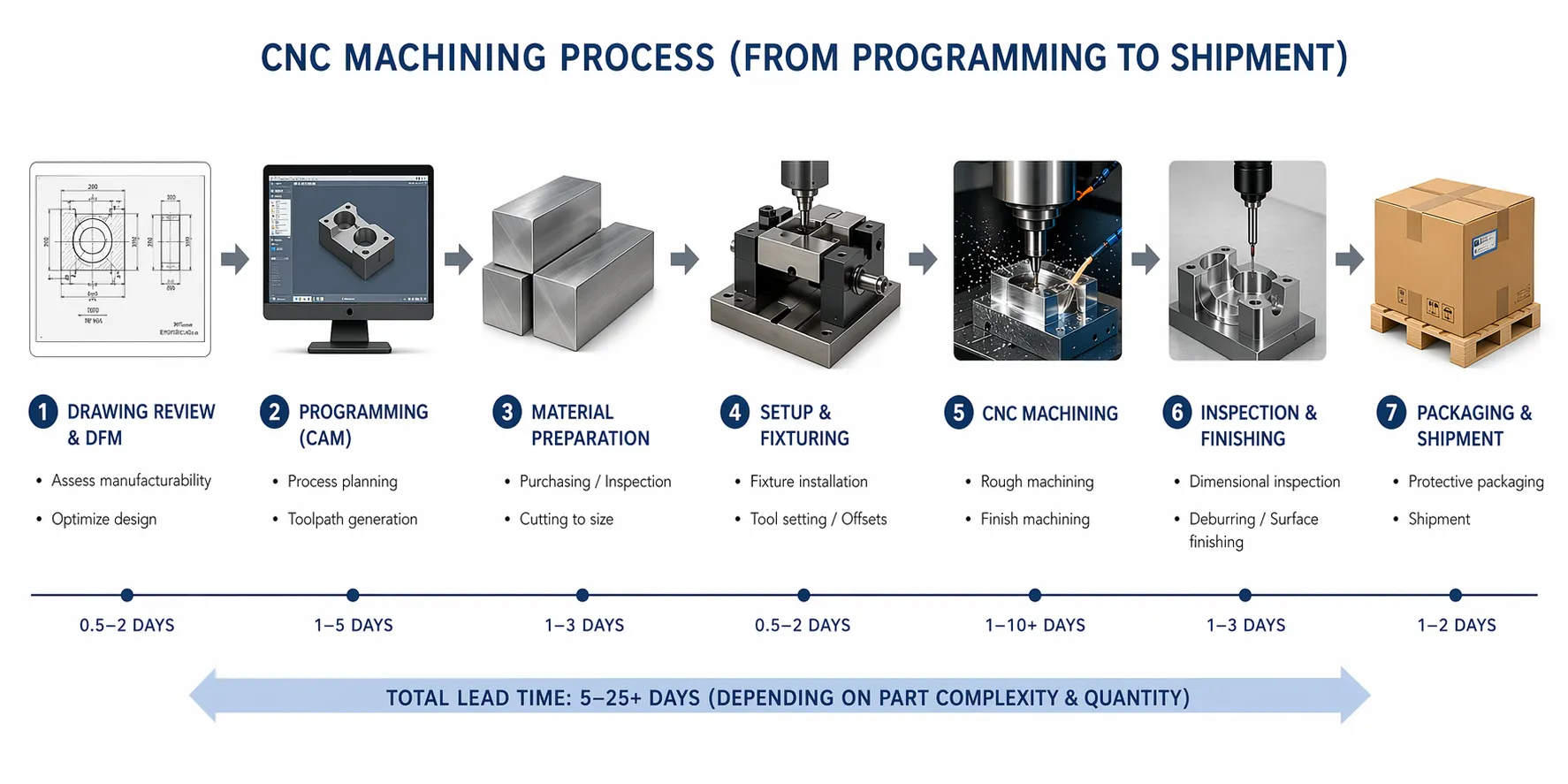
Lead time includes multiple stages beyond machining.
Standard Process Timeline
| Stage | Time Range |
|---|---|
| Drawing review & DFM | 0.5–2 days |
| Programming (CAM) | 1–5 days |
| Material sourcing | 1–3 days |
| Setup & fixturing | 0.5–2 days |
| Machining | 1–10+ days |
| Inspection & finishing | 1–3 days |
For simple parts, machining dominates; for complex parts, programming and setup become the main bottlenecks.
Key Factors That Affect CNC Machining Lead Time
1. Material Availability
Common materials are fast to source, while special alloys or certifications may delay production.
→ May add 1–5 days depending on sourcing requirements
2. Part Geometry and Tolerance
Complex geometry increases programming, setup, and inspection time.
→ Can extend lead time by 30%–100% in complex parts
3. Order Quantity
Setup time is fixed, but production scales with volume.
→ Large orders may require staged delivery instead of single shipment
4. Surface Finishing
Post-processing time varies significantly by method.
→ May add hours to several days, depending on process type
5. Production Capacity
Factory workload directly affects scheduling.
→ Full production queues may delay start time even for simple parts
6. Inspection Requirements
Additional inspection increases final delivery time.
→ May add 1–3 days depending on documentation requirements
7. Drawing Quality
Incomplete drawings delay engineering and production.
→ Can delay quoting and production by 1–3 days or more
How Buyers Can Reduce CNC Machining Lead Time
To improve delivery speed and avoid unexpected delays, buyers should focus on providing complete and decision-critical information early.
1. Provide Complete Drawings and Files
Include 2D drawings with tolerances and 3D models
→ Missing or unclear drawings can delay programming by 1–3 days
2. Confirm Material and Surface Treatment Early
Specify material grade and finishing requirements
→ Late changes may cause re-sourcing or reprocessing delays (2–5 days)
3. Define Critical Dimensions Clearly
Highlight function-critical tolerances
→ Over-specifying tolerance can increase inspection time and lead time by 20%–50%
4. Avoid Late Design Changes
Freeze design before production starts
→ Changes after programming may restart the process, adding several days of delay
5. Clarify What the Quoted Lead Time Includes
Confirm if finishing and inspection are included
→ Misunderstanding scope may result in unexpected additional lead time
6. Check Production Capacity
Ensure the supplier has available machine capacity
→ Overloaded schedules can delay production even for simple parts
7. Confirm Batch Delivery Options
For large orders, ask about partial shipments
→ Partial delivery can reduce waiting time and improve scheduling
8. Provide Real Project Deadlines
Share actual assembly or release schedule
→ Helps suppliers prioritize and optimize production planning
How Fast Can CNC Machining Be (Rush Orders)
Rush orders can reduce waiting time but not eliminate process steps.
Typical Rush Lead Time
Simple parts → 2–4 days
Medium complexity → 5–10 days
Complex parts → limited reduction
Even under rush conditions, lead time is rarely reduced by more than 30%–50% due to programming and setup constraints.
This level of acceleration is more feasible for simple or moderately complex parts, but limited for highly complex geometries.
What Happens If Lead Time Is Misjudged
Incorrect planning creates downstream risks.
Common Consequences
Delayed assembly or product launch
Increased cost due to urgent scheduling
Multiple revisions from rushed production
Lead time may increase by 20%–50% due to rework, redesign, or production rescheduling.
FAQ
Is CNC machining lead time only about machining?
No. Programming and setup are often the biggest contributors.
Can all parts be delivered in a few days?
No. Complexity limits how much lead time can be reduced.
What methods can be used to shorten delivery time for parts undergoing batch testing?
Yes, hybrid manufacturing methods can be used, allowing you to test your parts faster and reduce costs.
Is there a quick way to find out the delivery time for CNC machining?
The delivery time calculator can quickly calculate the delivery time of parts.

If your project is urgent, feel free to contact us — we will provide a clear production lead time within 24 hours.