
Compare Custom Part Fabrication Lead Times (2026 Data)
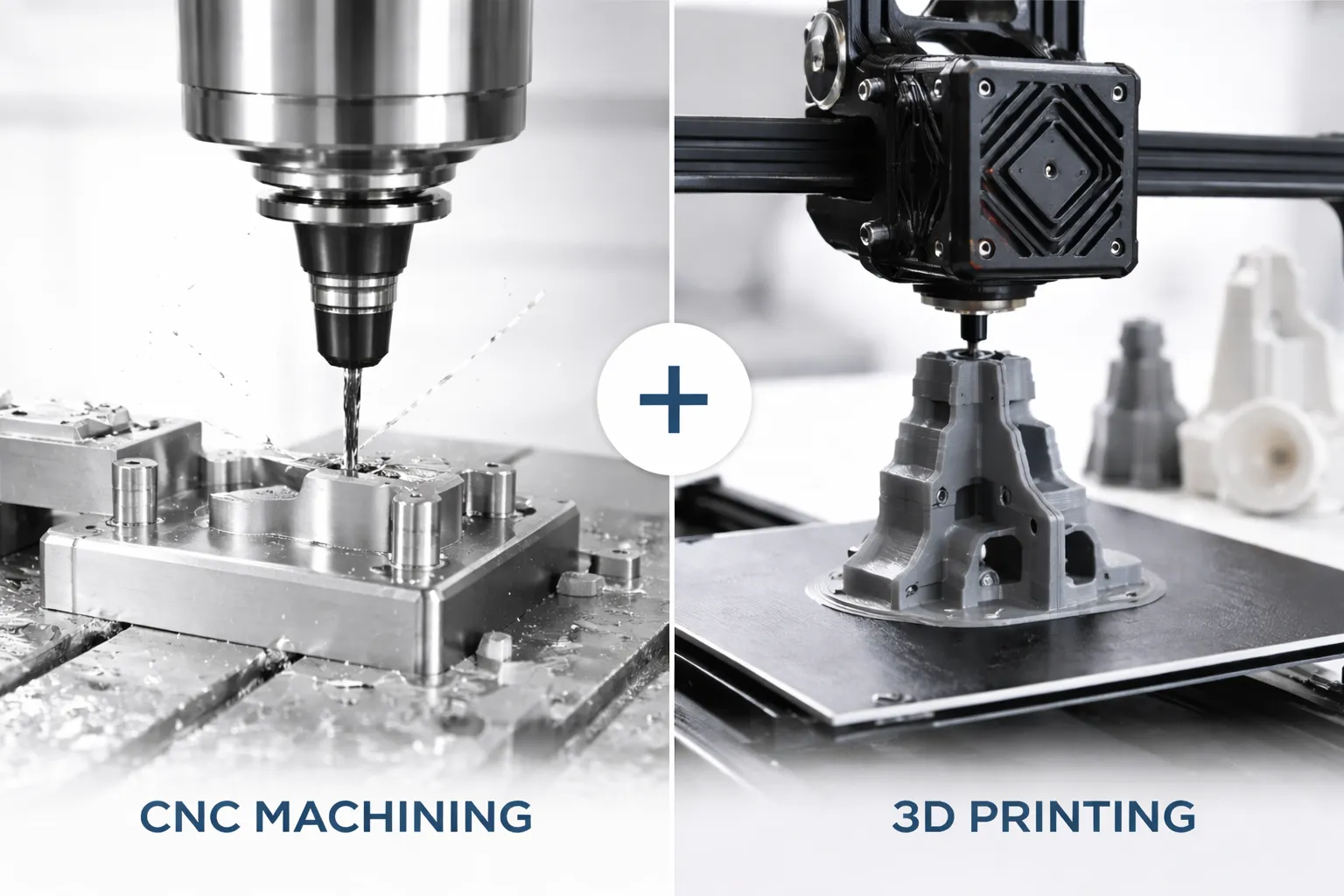
When evaluating custom manufacturing timelines in 2026, the baseline has shifted. Standard CNC machining typically requires 10 to 15 days for low-volume production, while industrial 3D printing can deliver prototypes in just 1 to 3 days. However, the "fastest" method completely depends on your required volume, material properties, and dimensional tolerances. As manufacturing engineers, we rely on data to match your specific project requirements to the fabrication process that guarantees the shortest critical path to delivery.
Key Takeaways
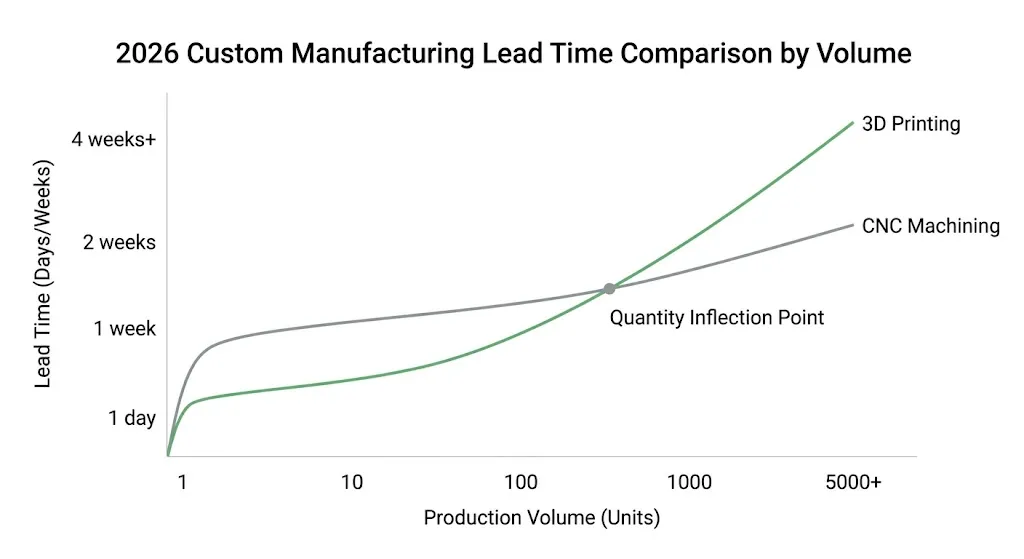
Speed vs. Volume Intersection: 3D printing dominates prototyping speed (1-10 parts), but CNC machining overtakes it in total turnaround time when order volumes scale past 50 units.
Setup Time Impact: CNC machining requires 2 to 4 hours of upfront CAM programming and fixturing, whereas 3D printing requires near-zero physical setup, allowing for same-day production starts.
Material Constraints: Custom fabrication in engineering-grade metals (like Titanium or Inconel) generally adds 5-7 days to any process due to specialized tool wear or raw material procurement.
The DFM Advantage: Applying specific Design for Manufacturing (DFM) rules can reduce traditional machining schedules by up to 30%, bringing CNC timelines closer to rapid prototyping speeds.
2026 Fabrication Lead Time Comparison Matrix
Selecting the right process dictates your entire production schedule. While additive manufacturing offers zero tooling delays, subtractive methods like CNC machining provide the necessary speed for mid-to-high volume runs. Use the 2026 data matrix below to align your volume with the fastest fabrication technology.
| 🏭 Fabrication Process | ⚙️ Upfront Setup Time | 📦 Prototype (1-10 pcs) | 📈 Low-Volume (10-100 pcs) | 🚀 Best Application |
| Industrial 3D Printing (SLA/SLS) | < 1 Hour | 1 - 3 Days | 5 - 7 Days | Rapid form/fit testing, complex internal geometries. |
| CNC Machining (3/5-Axis) | 2 - 6 Hours | 3 - 5 Days | 10 - 15 Days | Functional metal parts, tight tolerances, end-use components. |
| Sheet Metal Fabrication | 1 - 3 Hours | 4 - 6 Days | 7 - 12 Days | Enclosures, brackets, flat-pattern components. |
| Rapid Injection Molding | 1 - 3 Weeks (Tooling) | N/A | 3 - 4 Weeks | Scaling to 1,000+ plastic parts with consistent finish. |
Engineer's Note: These 2026 benchmarks assume you are using standard, in-stock materials. Requesting secondary surface treatments (like anodizing or powder coating) will uniformly add 3 to 5 days across all subtractive and sheet metal processes.
CNC Machining vs. 3D Printing: The Timeline Trade-off
The choice between additive and subtractive manufacturing dictates the trajectory of your project schedule. While 3D printing wins the race on day one due to the absence of physical tooling, CNC machining offers superior scalability and material integrity once the initial setup is complete.
For immediate rapid prototyping turnaround, 3D printing is unmatched. A CAD file can be sent to our fleet of 15+ industrial Stratasys and Formlabs printers and begin building within minutes.
However, CNC machining is faster for low-volume production. Once a 5-axis CNC program is verified and the workholding is set, the actual machine cycle time per part is significantly shorter than the layer-by-layer build time of a 3D printer. If you need 50 aluminum brackets, CNC will typically finish the batch days before an industrial printer could.
How DFM Accelerates Your Chosen Fabrication Method
Regardless of the manufacturing process you select, unoptimized CAD files are the universal bottleneck. Applying strict Design for Manufacturing (DFM) principles prevents your project from being stalled in the engineering clarification queue, getting your parts on the machines faster.
To ensure the fastest custom manufacturing timelines, implement these process-specific optimizations before requesting a quote:
Optimize for CNC: Standardize your internal fillet radii to allow for larger, faster end mills. Consolidate your design to minimize manual part flipping.
Optimize for 3D Printing: Design parts to minimize the need for support structures. Removing heavy supports adds significant manual post-processing time to your delivery schedule.
Simplify Tolerances: Across all fabrication methods, over-tolerancing non-critical dimensions forces operators to slow down machine speeds and increases the Outgoing Quality Control (OQC) inspection time.
Case Study: Hybrid Fabrication to Save 3 Weeks
Process selection is not always an either/or decision. When a client requires immediate functional testing followed by a reliable pilot run, utilizing parallel fabrication methods delivers the fastest possible market entry.
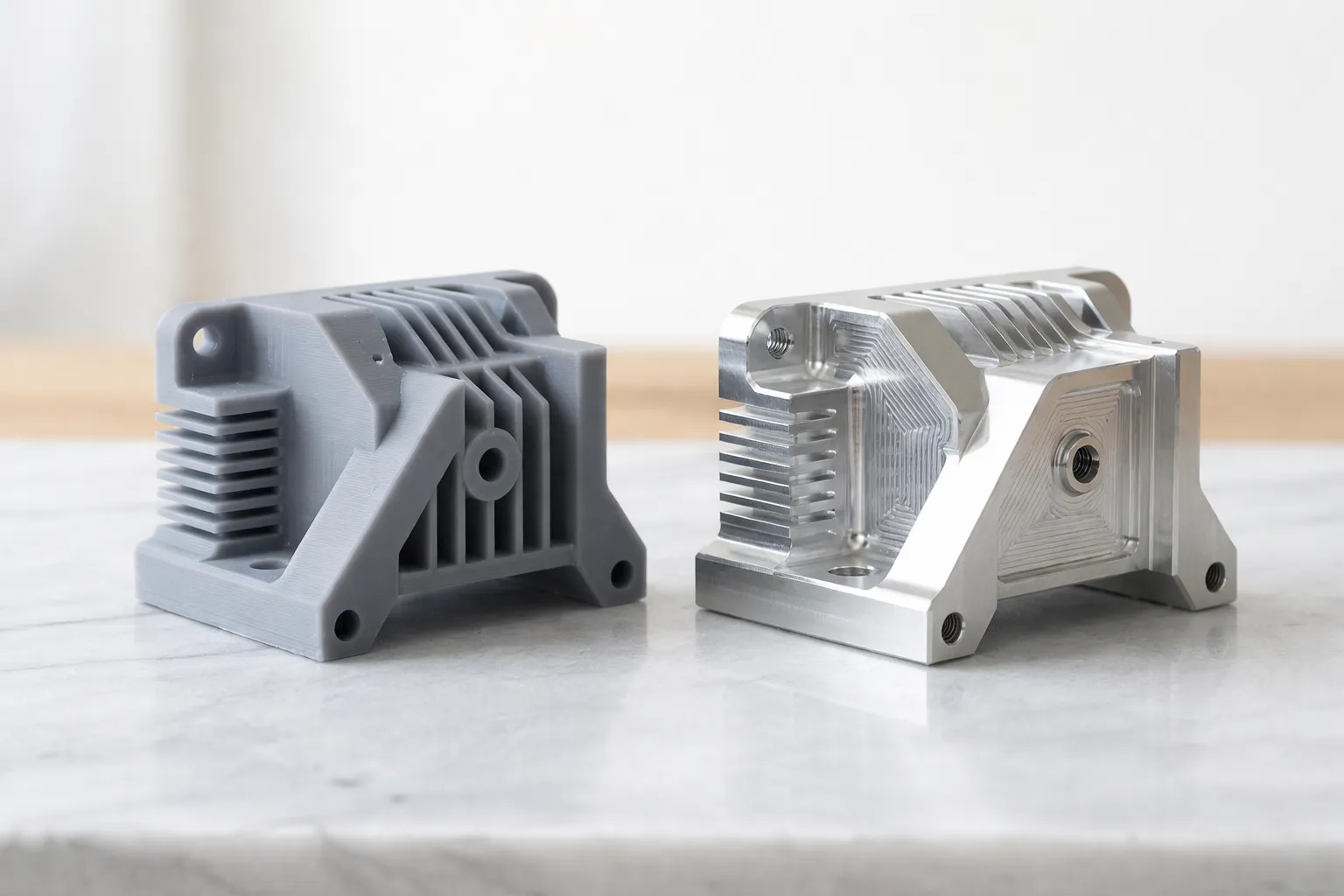
The Challenge: An automotive client needed a custom sensor housing. They required 2 units immediately for fit-testing, and 100 units for a field trial. Standard CNC lead time for the full batch was 18 days.
The Engineering Solution: We split the manufacturing strategy. We immediately sent the CAD to our 3D printing department while simultaneously programming the CAM toolpaths for the CNC pilot run.
The Result: The client received the 3D printed fit-test models in 48 hours. They verified the dimensions, allowing us to confidently push the start button on our CNC mills. The entire 100-piece metal batch was delivered on Day 15, eliminating the risk of machining 100 useless parts.
Frequently Asked Questions (FAQ)
Q: Does 3D printing always offer a faster lead time than CNC?
A: Only for very low volumes (1-10 parts) or highly complex geometries that would require multiple CNC setups. For volumes exceeding 50 units in metal or standard plastics, CNC is almost always faster.
Q: How do secondary finishes impact the fabrication schedule?
A: Finishes like bead blasting add less than 24 hours. However, chemical processes like hard anodizing or electroplating require external batch processing, which typically adds 3 to 5 days to any fabrication timeline.
Q: What is the fastest material to machine or print in 2026?
A: For CNC machining, Aluminum 6061 and Delrin (POM) offer the fastest material removal rates and are abundantly stocked. For 3D printing, standard UV resins (SLA) or Nylon powders (SLS) provide the quickest build times.
Get Your Data-Driven Lead Time Estimate
Don't guess your production schedule. [Upload your 3D CAD files today] to our system. Our engineering team will analyze your geometry and provide a 24-hour quote, recommending the exact fabrication process to hit your deadline.