
What Is the MOQ for Custom Sheet Metal Fabrication? A Buyer's Guide for Prototypes and Low-Volume Orders
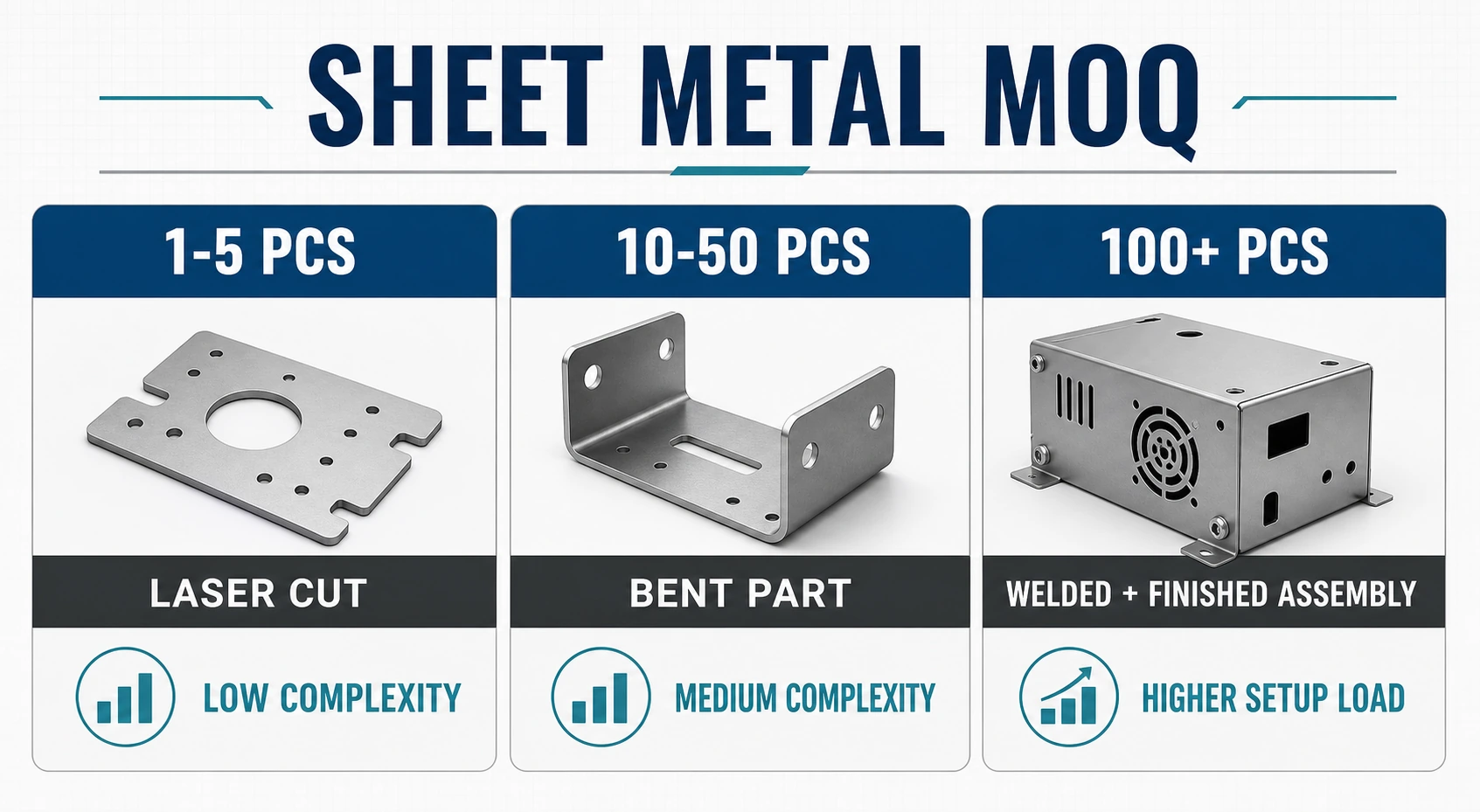 If you are sourcing custom sheet metal parts for a prototype, pilot build, or low-volume product launch, one of the first questions is usually simple: what is the MOQ?
The short answer is that custom sheet metal fabrication usually does not have one universal minimum order quantity. In many projects, the workable order quantity depends on material, sheet thickness, cutting method, bending complexity, welding, hardware insertion, surface finish, inspection requirements, and how much setup work the job requires.
For buyers, that distinction matters. A supplier may be technically able to produce one part, five parts, or fifty parts, but the real question is whether the order is practical, cost-efficient, and aligned with your quality and schedule requirements.
This guide explains why MOQ exists in sheet metal fabrication, when low quantities are realistic, what pushes MOQ higher, and how to prepare an RFQ that helps a supplier review your project accurately.
Quick Answer: Is There a Fixed MOQ for Sheet Metal Fabrication?
Usually, no.
For custom sheet metal fabrication, MOQ is often a commercial and process decision rather than a fixed rule. A supplier may support prototype quantities, but the unit price will usually be higher when programming, material handling, press brake setup, welding, finishing, or inspection work must be spread across only a few parts.
In practice:
a simple laser-cut flat part may be practical in a very small quantity
a bent bracket or simple cover can often be reviewed for prototype volume
a welded or cosmetically finished assembly may need a larger batch to make processing more efficient
This is why a serious supplier will ask for drawings, material, thickness, finish, and quantity before giving a confident MOQ answer.
Why MOQ Exists in Sheet Metal Fabrication
MOQ is not only about factory preference. It exists because every custom job has setup work that does not disappear just because the batch is small.
Material Purchasing and Sheet Utilization
Some materials are easy to source in common grades and thicknesses. Others are not. If your project uses a standard material such as 304 stainless steel, 5052 aluminum, or cold rolled steel in a common gauge, a supplier has more flexibility to review a small batch.
If the project uses an uncommon thickness, special alloy, finish-sensitive material, or a very low quantity that leaves unusable stock, the practical MOQ may rise.
Cutting, Bending, Welding, and Finishing Setup
Laser cutting is relatively flexible because the setup is mostly digital. Once the CAD or DXF file is ready and nesting is confirmed, small quantities may still be reasonable.
But many sheet metal jobs also require:
press brake setup
bend sequence review
deburring
welding or spot welding
PEM nuts, studs, or other inserted hardware
powder coating, plating, brushing, or anodizing
dimensional inspection
Each added step increases handling and setup effort. That is why a five-piece order can be possible but still cost much more per unit than a fifty-piece order.
Secondary Processes Often Drive MOQ
Secondary processes can affect MOQ more than cutting alone.
Powder coating usually runs more efficiently in batches. Hardware insertion becomes easier to control when identical parts move through the same operation together. Welded assemblies may need fixtures or extra inspection time. Cosmetic parts may require more careful handling and rework control.
For this reason, a low-volume order with multiple finishes, welded features, and inserted hardware may be less efficient than a larger batch of simpler parts.
When Low-Quantity Sheet Metal Orders Are Still Practical
Low MOQ does not automatically mean bad fit. Many sheet metal jobs are practical in prototype or bridge-production volume when the design and process route are aligned.
Laser-Cut Flat Parts
Flat parts without forming are usually the easiest place to support low quantities. Mounting plates, panels, simple covers, and brackets that only require cutting and deburring are easier to schedule and quote than multi-process assemblies.
Simple Bent Brackets and Covers
A part with standard bends can often be reviewed for low-volume production, especially when:
the material is common
bend radii are realistic
no special tooling is required
cosmetic finishing is limited
tolerances are appropriate for sheet metal
Prototype Enclosures and Bridge Production
Prototype enclosures, control boxes, sheet metal chassis, machine covers, and automation brackets often start in small quantities. A supplier can help buyers review whether the first run should be one prototype set, a pilot batch, or a bridge-production quantity.
What Usually Pushes MOQ Higher?
| Factor | Why It Can Increase MOQ |
|---|---|
| Uncommon material or thickness | Extra stock may be required and leftover material may be difficult to reuse. |
| Multiple bends or tight bend sequence | More press brake setup and review time is needed. |
| Welding or assembly | Fixtures, alignment, and inspection add labor. |
| Powder coating or plating | Batch processing is more efficient than one-off finishing. |
| Very tight tolerances | More inspection and process control are required. |
| Cosmetic surfaces | Handling, masking, and rework risk increase. |
The key point is that MOQ is usually connected to process effort, not only quantity.
How Buyers Can Reduce MOQ Pressure Without Sacrificing Quality
If your target quantity is small, the best strategy is not to ask for the lowest possible MOQ without context. It is to make the job easier to review and manufacture.
Useful steps include:
choose common material and thickness when possible
keep bend radii realistic and consistent
avoid tight tolerances unless they are functionally necessary
mark cosmetic surfaces clearly
separate prototype goals from production goals
confirm whether hardware insertion, welding, and finishing are needed in the first batch
send both 3D CAD and 2D drawings
This gives the supplier a better chance to propose a workable low-volume route.
What to Send for a Faster MOQ and Quote Review
To get a useful answer instead of a generic sales reply, buyers should send:
3D CAD
2D drawings
material and thickness
quantity and expected future volume
finish requirements
hardware requirements
weld notes
critical dimensions
cosmetic surface notes
target delivery timing
Without this information, MOQ discussions stay abstract. With it, the supplier can explain whether the target quantity is practical, whether a quantity break would help, or whether a design adjustment could reduce cost.
How Fengnuo Supports Prototype and Low-Volume Sheet Metal Projects
Fengnuo's current sheet metal fabrication service already supports cutting, bending, welding, hardware insertion, finishing, and drawing-based manufacturability review. The service page also explicitly positions the process for prototype, bridge-run, batch, and repeat production work.
For buyers, the practical takeaway is that MOQ should be treated as part of manufacturability review, not as a one-line policy. A flat bracket may be workable at a very small quantity. A welded and powder-coated enclosure may still be possible, but the quantity decision should be reviewed together with drawing completeness, finish demands, and inspection expectations.
If your project also includes machined mating parts, prototype fixtures, or secondary processes, Fengnuo's broader CNC machining services, 3D printing, and request a quote page give buyers a practical next step without switching suppliers.
Buyers who are comparing timing across manufacturing routes can also review compare custom part fabrication lead times for a broader process-planning reference.
FAQ
Can custom sheet metal parts be ordered in very low quantities?
Often yes, especially for laser-cut parts or simple formed parts. Feasibility still depends on material, forming complexity, finishing, and inspection requirements.
Why does unit price rise on very small sheet metal orders?
Because programming, material handling, bending, welding, finishing, and inspection effort must be spread across fewer parts.
Is there usually a no-MOQ policy for sheet metal fabrication?
Some suppliers support very small orders, but that should not be treated as a universal promise. The better question is whether your specific drawing is practical at the target quantity.
What usually increases MOQ on sheet metal parts?
Special materials, multiple bends, welding, hardware insertion, cosmetic finishing, and batch-dependent secondary processes are common reasons.
How can I get a more accurate answer from a supplier?
Send CAD, drawings, material, thickness, quantity, finish, hardware, critical dimensions, and delivery expectations so the supplier can review the real manufacturing path.