
How Long Does Sheet Metal Fabrication Take? A Practical Lead Time Guide for Prototypes and Low-Volume Orders
When buyers ask about sheet metal fabrication lead time, they usually want a simple answer: how fast can the parts move from drawing review to finished delivery, and what usually slows the schedule down?
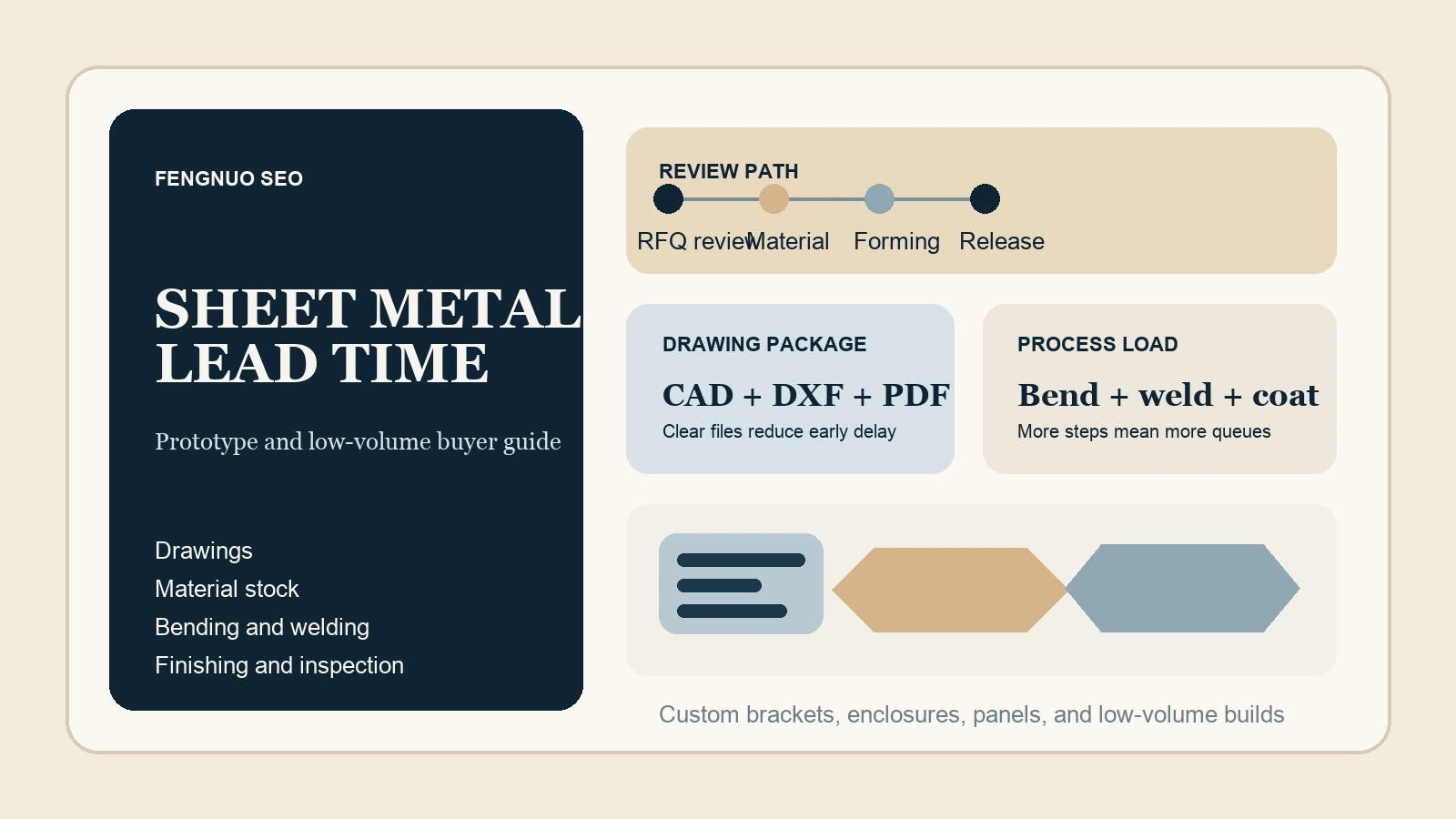
The short answer is that there is no single universal lead time for custom sheet metal parts. A flat laser-cut plate, a bent bracket, and a welded, powder-coated enclosure may all start from sheet metal, but they do not move through the factory at the same speed.
For prototype and low-volume projects, lead time is usually controlled less by raw machine speed and more by engineering clarity, material availability, bend complexity, welding, hardware insertion, surface finishing, inspection, and release planning.
That matters for overseas buyers because a quote that looks fast on paper is not the same as a part that can be manufactured, inspected, and shipped without rework. The practical goal is not only to ask for a short schedule. It is to reduce the hidden delays that make schedules slip.
This guide explains what actually affects sheet metal fabrication lead time, which jobs usually move faster, what tends to create delay, and how to prepare an RFQ that helps a supplier review your project more efficiently.
Quick Answer: What Really Determines Sheet Metal Fabrication Lead Time?
Sheet metal fabrication lead time is usually shaped by six work stages:
drawing review and manufacturability check
material and thickness confirmation
cutting, nesting, and forming setup
welding, hardware insertion, and assembly work
surface finishing and cosmetic handling
inspection, packing, and shipment release
That is why buyers should be careful with generic lead-time promises. A supplier may review a simple bracket quickly, but a multi-step enclosure project with welding, PEM hardware, masking, and powder coating will naturally need more coordination.
The fastest projects are usually the ones with complete files, common materials, practical bends, stable revisions, and clearly defined finishing and inspection requirements.
What Steps Actually Control Lead Time?
Many buyers think lead time starts when the laser or press brake starts running. In practice, important time is often spent before fabrication begins and after the last forming operation is completed.
Before production, the supplier still needs to review the drawing, confirm whether the material is in stock, check bend feasibility, decide how the part will be nested and formed, and flag any issues with hole-to-bend distances, hardware clearance, or finish-sensitive surfaces.
After fabrication, the part may still require deburring, welding cleanup, hardware insertion, coating, masking, dimensional checks, packing, and export preparation. A project that looks simple in CAD can still become schedule-sensitive once these downstream steps are included.
For that reason, the right buyer question is not just "How fast can you make it?" A better question is "Which step in this part is most likely to extend the schedule?"
Which Sheet Metal Jobs Usually Move Faster?
Not every sheet metal project carries the same delivery risk. In general, the following types of jobs are easier to review and schedule:
Laser-Cut Flat Parts
Flat parts without forming are usually the simplest place to support faster schedules. Mounting plates, simple panels, covers, and blanks can often move more smoothly because they avoid bend setup, weld distortion risk, and finish-sensitive fit issues.
Simple Bent Brackets and Covers
Parts with a few standard bends, common material thicknesses, and no unusual hardware are often more predictable than complex assemblies. The fewer stations a part needs to visit, the easier it is to control queue time.
Prototype Panels with Standard Materials and Hardware
Prototype work can still move efficiently when the part uses stocked sheet material, standard PEM hardware, realistic bend radii, and a clear drawing package. Low volume does not automatically create delay. Unclear requirements create delay.
What Usually Makes Lead Time Longer?
Lead time usually expands when the drawing or process path adds uncertainty. The most common schedule drivers are listed below.
Incomplete Drawings or Revision Changes
If the supplier receives a CAD file without a clear 2D drawing, key details may still be missing:
critical dimensions
bend notes
hardware positions
finish callouts
masking zones
inspection requirements
Even small missing details can hold the job because engineering review cannot be closed safely. Revision changes after quote approval are another common source of delay because programs, flat patterns, fixtures, and inspection notes may need to be checked again.
Non-Stock Materials or Uncommon Thicknesses
Common stainless steel, aluminum, cold rolled steel, and galvanized steel usually move more easily than rare grades or unusual thicknesses. If a project needs non-standard sheet stock, special tempers, or finish-sensitive material, procurement time may become the real bottleneck.
For prototypes, buyers should decide early whether an equivalent stocked material is acceptable. If substitution is possible, it may help reduce waiting time without affecting the main design objective.
High Bend Counts, Welding, and Fit-Critical Hardware
A part with one or two bends is very different from an enclosure with multiple formed sides, welded corners, PEM studs, rivets, and assembly features. Each added process creates another queue, another setup, and another quality checkpoint.
Welding can slow schedules because it adds fixture planning, distortion control, cleanup, and inspection risk. Hardware insertion can also become a bigger time driver than buyers expect, especially when edge distance, bend clearance, or finish protection must be controlled carefully.
Surface Finishing and Cosmetic Requirements
Powder coating, plating, anodizing, brushing, masking, silk screening, and other secondary processes all add scheduling dependencies. Finishing often works in batches, and cosmetic parts usually need more handling discipline than internal structural parts.
This matters because a fabricated part may be complete from a forming perspective while still waiting for coating capacity, color confirmation, masking review, or post-finish inspection.
Inspection and Release Requirements
If the project needs dimensional reports, first-article style verification, hardware position checks, or fit-sensitive measurements after finishing, that inspection scope should be discussed before quote approval. Inspection does not just happen at the end. It affects how the whole job is planned.
Lead Time Drivers Buyers Should Review Early
The most useful lead-time review is not a long table. Buyers should look at each driver and ask what information the supplier needs before production can be released.
Material Stock
Material availability can become the first delay if the required grade or thickness is not common. Buyers can reduce this risk by confirming whether a stocked equivalent is acceptable before the schedule is locked.
Bend Complexity
More bends usually mean more setup review, bend-sequence planning, and angle checks. A design that uses practical bend radii and avoids unnecessary formed features is easier to release quickly.
Welding and Hardware
Welded assemblies, PEM hardware, rivets, inserts, and fit-critical features add manual operations and inspection points. Defining these requirements early helps the supplier avoid late fixture or clearance questions.
Surface Finishing
Powder coating, plating, brushing, masking, and cosmetic handling often depend on batch scheduling. Buyers should confirm color, finish standard, cosmetic surfaces, and masking zones before quote approval.
Inspection Scope
Dimensional reports, first-article style checks, hardware position review, and post-finish inspection can affect the release plan. Marking critical dimensions clearly gives the supplier a better way to plan quality checks without delaying shipment.
How Buyers Can Shorten Lead Time Without Creating Quality Risk
The safest way to reduce lead time is not to remove important process steps. It is to remove avoidable uncertainty before the job is released.
1. Send a Complete RFQ Package
Fengnuo's public sheet metal fabrication service page already asks buyers to send CAD, DXF, drawings, quantity, material, thickness, finish, hardware, and critical dimensions before quote review. That is the right starting point because incomplete RFQs usually create more back-and-forth than any machine process.
A strong RFQ package should usually include:
3D CAD file when available
2D PDF drawing with key dimensions
exact material grade
thickness
quantity and quantity tiers
finish requirement
hardware requirement
critical tolerances or fit notes
target delivery expectation
shipping destination or export note when relevant
2. Mark the Finished Condition Clearly
For fabricated parts, a dimension may matter before coating, after coating, after PEM insertion, or after final assembly. If that finished condition is not stated, buyers and suppliers may be discussing different inspection states without realizing it.
That is especially important for:
hole-to-bend distance
hardware position
mating faces
grounding zones
masked threads
coating-sensitive fits
3. Use Practical Design Rules for Prototype Parts
Prototype work often moves faster when the design avoids unnecessary complexity. A few examples:
keep holes away from bend lines when possible
use practical inside bend radii
avoid very short flanges
standardize PEM hardware sizes
mark only truly critical tolerances
These choices help reduce setup changes and rework risk without reducing functional value.
4. Discuss Partial Delivery if the Project Is Time-Sensitive
For pilot builds or urgent test programs, a buyer does not always need the full quantity on the same day. In some cases, the first batch can be prioritized for verification while the remaining parts continue through finishing or final packing.
This is often a useful discussion point when the project includes both simple and complex parts in one build package.
5. Ask for DFM Feedback Before Freezing the Schedule
If the project timeline is critical, ask which feature is most likely to slow fabrication. That may be a bend sequence issue, a hole placement problem, a cosmetic finish dependency, or a hardware clearance conflict. Fixing that issue early is usually easier than trying to rush the job after release.
What to Send for a Faster Quote and Production Review
If your goal is not just pricing but also a more realistic delivery plan, send the supplier enough information to review the actual manufacturing route.
Recommended RFQ inputs:
STEP, STP, DXF, DWG, or equivalent CAD files
2D drawings with dimensions and tolerances
material grade and thickness
quantity and urgency level
finish or cosmetic requirement
hardware list or callouts
weld notes when relevant
critical fit dimensions
inspection or report requirements
target delivery date
Buyers comparing multiple processes may also benefit from reviewing compare custom fabrication lead times and deciding whether a part really belongs in sheet metal, CNC machining services, or even 3D printing service for early-stage validation.
How Fengnuo Supports Prototype and Low-Volume Sheet Metal Projects
Based on the current public service page, Fengnuo supports laser cutting, CNC punching, press brake bending, welding, hardware insertion, deburring, finishing, and inspection for custom sheet metal projects.
The same page also states that Fengnuo supports:
prototype orders
bridge runs
batch production
repeat production
That is useful for overseas buyers because many RFQs do not stay in one volume bracket forever. A project may begin as a prototype enclosure or bracket set, then move into repeat low-volume builds after fit validation.
Fengnuo's sheet metal page also states that quote feedback can be provided within 24 hours after the required files are submitted. That quote speed should not be confused with production speed, but it is still valuable because faster engineering review helps buyers identify delivery risk earlier.
If your project includes sheet metal together with machined features, inserts, or related prototype work, it may also make sense to coordinate the schedule with Fengnuo's broader manufacturing services rather than reviewing each process in isolation.
If you already have drawings ready, you can request a quote with the required files so the engineering review starts from the real part requirements rather than a rough description.
Get a Quote for Your Sheet Metal Project
Ready for quote review
Send your drawings for a faster sheet metal quotation
If you are comparing suppliers for a prototype enclosure, bracket, panel, or low-volume assembly, Fengnuo can review the job based on the real manufacturing route instead of a generic lead-time promise.
To speed up the quote review, send:
3D CAD or flat-pattern files
2D drawings with key dimensions
material and thickness
quantity and delivery target
finish, hardware, or welding requirements
inspection notes or fit-critical features
If you are still comparing options, mention whether the project is for prototype validation, bridge production, or repeat low-volume supply. That helps the engineering team review the most practical production path from the start.
Prototype partsBridge productionRepeat low volume
Use the contact page to request custom sheet metal fabrication, related machining support, or a mixed-process prototype build.
FAQ
Is there a standard lead time for sheet metal fabrication?
No. Lead time depends on the actual manufacturing route. Material availability, bend count, welding, hardware insertion, finishing, inspection, and quantity all affect the schedule.
Do prototypes always move faster than production orders?
Not always. A simple prototype can move quickly, but a low-volume prototype with welding, coating, hardware, and fit-critical requirements may still take careful review. The design and process path matter more than the word prototype.
Does powder coating or plating usually extend lead time?
Yes, secondary finishing often adds schedule dependency because parts may wait for coating capacity, masking review, color confirmation, or post-finish inspection.
What files help a supplier review lead time faster?
Send CAD files, 2D drawings, material, thickness, quantity, finish, hardware details, and any inspection requirements. The more complete the RFQ is, the easier it is to review the real process path.
Can low-volume sheet metal orders still include welding and hardware insertion?
Yes, they can, but those steps usually add more handling and review time than flat cutting alone. Buyers should define those requirements early so the supplier can judge the actual delivery risk.