
CNC Machining for Consumer Products: From Functional Prototypes to Low-Volume Production
Consumer products often look simple from the outside, but the parts behind the appearance can be demanding to manufacture. A compact enclosure may need clean cosmetic surfaces, reliable threads, accurate button openings, controlled gaps, stable assembly datums, and enough strength for repeated use.
CNC machining is useful when a consumer-product team needs parts made from real engineering materials rather than visual mockup materials. It can support functional prototypes, presentation-ready housings, test fixtures, pilot builds, replacement components, and low-volume production before a higher-volume process is justified.
The right question is not whether every consumer product should be CNC machined. It is which parts need CNC machining, at which development stage, and what information a supplier needs to produce them reliably.
Quick Answer: When Does CNC Machining Fit Consumer Products?
CNC machining is a strong fit when a product needs functional material behavior, accurate assembly interfaces, threaded features, heat-resistant or rigid components, premium metal surfaces, or a repeatable small batch.
Typical applications include:
aluminum and plastic device housings;
wearable frames and structural carriers;
control knobs, buttons, dials, and bezels;
camera, sensor, audio, and smart-device enclosures;
internal brackets, heat-management parts, and mounting plates;
assembly fixtures and product test components; and
pilot quantities used before tooling or mass-production release.
For early shape and appearance checks, a 3D printing service may be the faster learning tool. CNC becomes more valuable when the team must evaluate the final material, assembly behavior, durability, finish, or repeatability.
Consumer Product Parts Are Not All Reviewed the Same Way
Visible Housings, Frames, and Controls
Exterior parts influence how the user sees and touches the product. Their drawings may need to define cosmetic surfaces, edge breaks, texture direction, color, coating, allowable marks, gap-and-flush relationships, and which surfaces remain visible after assembly.
A dimensionally correct part can still fail a consumer-product review if its appearance is inconsistent or if the finish changes how adjacent pieces align.
Internal Structural and Functional Components
Hidden parts may carry loads, position sensors, support a circuit board, transfer heat, locate a connector, or hold a sealing surface. Appearance may be less important, but datum relationships, threads, flatness, stiffness, and assembly clearance can be critical.
The supplier needs to know which dimensions control the product function. Applying the same strict requirement to every surface can add machining and inspection effort without improving performance.
Test Fixtures and Development Hardware
Product development also creates a need for fixtures, alignment blocks, test adapters, inspection nests, and assembly aids. These parts may never reach the end user, but they can determine whether prototypes and pilot products are tested consistently.
From Concept Model to Low-Volume Production
Stage 1: Form and Appearance Verification
At the earliest stage, the team may only need to review overall size, shape, grip, button position, display opening, or packaging fit. A printed or cast model can answer many of these questions without requiring the final production material.
Stage 2: Functional Prototype
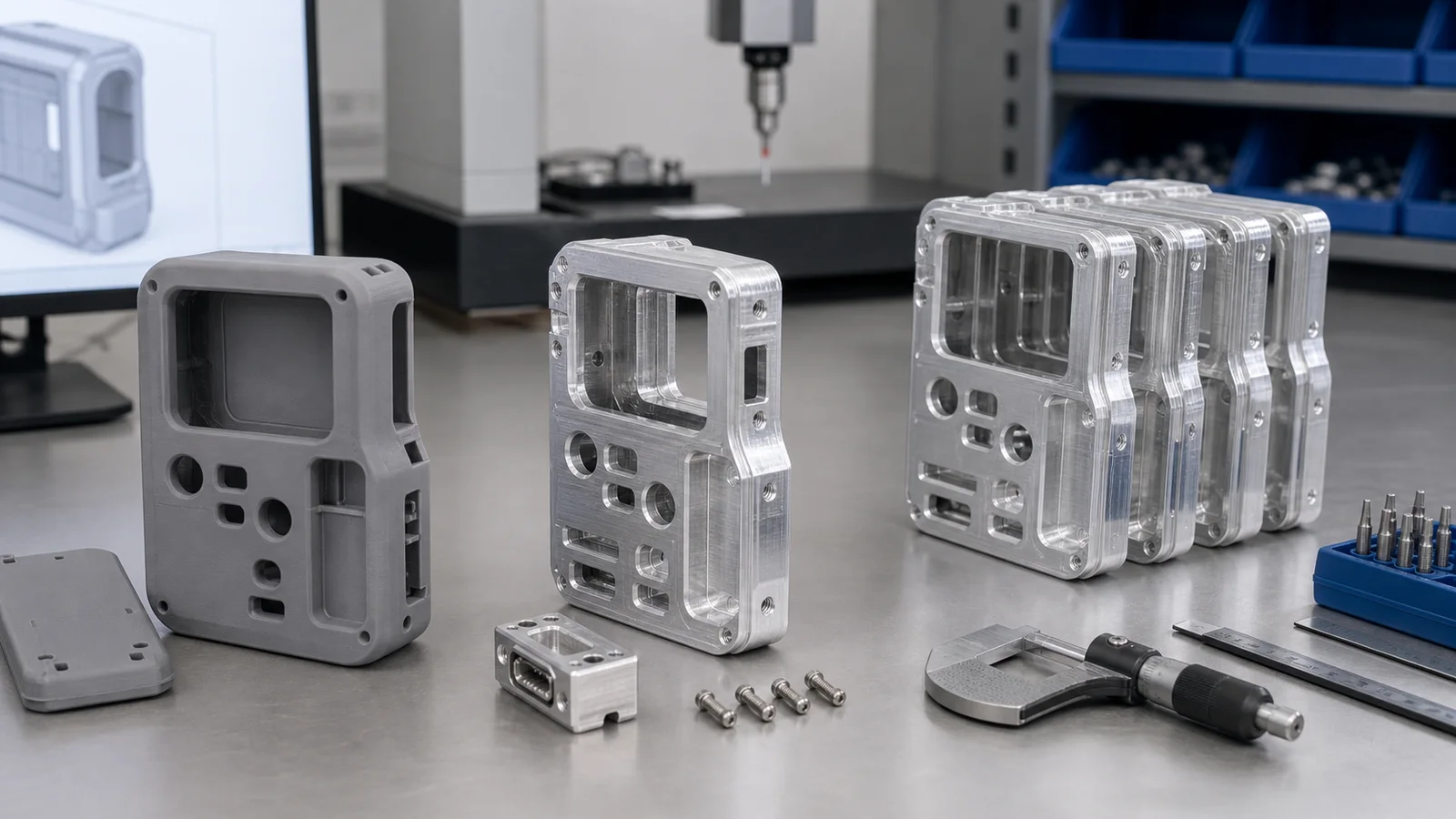
A CNC-machined prototype becomes useful when material stiffness, heat transfer, thread strength, fastener torque, sealing, connector alignment, or assembly fit must be tested. The goal is not simply to make a metal version of the concept. It is to verify the interfaces that control performance.
Stage 3: Pilot Build
A pilot batch helps the team evaluate more than one carefully prepared prototype. It can reveal assembly variation, finishing consistency, packaging risk, inspection needs, and whether the drawing communicates the design clearly enough for repeat production.
At this stage, revision control becomes important. The supplier and buyer should confirm which drawing and model are released, how nonconforming features will be handled, and whether first-piece approval is required before the remaining quantity proceeds.
Stage 4: Repeat Low-Volume Production
CNC machining can remain practical for premium products, specialized accessories, replacement components, limited editions, product launches, bridge production, and designs that are still evolving. The commercial fit depends on geometry, material, quantity, finishing, inspection, and future demand.
If demand grows and the design stabilizes, the team can compare CNC machining with casting, molding, sheet metal, or other production routes. The best process may change as quantity and design maturity change.
Material Choices for Consumer Product Components
Aluminum
Aluminum is often considered for housings, frames, controls, heat-management parts, and structural components because it combines low weight, machinability, and several finishing options. The exact alloy and temper should be selected around strength, appearance, corrosion exposure, machining behavior, and finishing requirements.
Stainless Steel
Stainless steel may suit compact high-wear components, premium controls, shafts, fastener-related parts, and parts exposed to moisture or repeated handling. It is heavier and may require a different machining and finishing strategy than aluminum, so it should be selected for a clear functional or appearance reason.
Engineering Plastics
Machined plastics can support electrical isolation, lower weight, sliding contact, chemical resistance, or a functional prototype closer to an eventual molded material. Plastic behavior varies widely, and the design should account for wall thickness, clamping, temperature, moisture, threads, and dimensional stability.
Design Details That Affect Cost, Quality, and Schedule
Cosmetic Zones
Mark visible surfaces and define the viewing condition. If a housing will be anodized, painted, brushed, blasted, or polished, discuss texture direction, masking, color expectations, and the acceptable location of fixture contact before production.
Wall Thickness and Tool Access
Deep cavities, thin walls, narrow slots, and small internal corner radii can require longer tools, lighter cutting, additional setups, or special workholding. Where function allows, practical wall thickness, accessible features, and larger internal radii can reduce manufacturing risk.
Threads, Inserts, and Fasteners
Specify thread standard, size, depth, engagement, insert requirements, and whether the feature is inspected before or after finishing. In small enclosures, thread position and edge distance can affect both machining and assembly strength.
Mating Faces and Gap-and-Flush Requirements
Consumer products often combine machined parts with displays, plastic covers, seals, buttons, circuit boards, or purchased hardware. Define the datum structure and the dimensions that control those interfaces. A general outside dimension may not be enough to protect assembly fit.
Post-Finish Dimensions
Coatings and surface treatments can affect holes, threads, contact areas, appearance, and fit. Drawings should identify masked surfaces and whether critical dimensions apply before or after finishing.
Moving a consumer product from appearance model to functional hardware?
Send the CAD model, drawing, material, cosmetic zones, finish, quantity, mating components, and critical interfaces. Fengnuo can review whether CNC machining fits the next development stage. Send your product files for manufacturing review.
Quality Planning for Consumer Product Parts
Quality planning should match how the part functions and how the user experiences it. A cosmetic housing may need visual standards and consistent finish, while an internal frame may need positional measurements and assembly checks.
Useful controls may include:
drawing and revision review before production;
incoming material confirmation;
in-process checks of critical features;
thread, connector, and mating-component checks;
cosmetic review under an agreed condition;
post-finish dimensional checks where required; and
packing methods that protect visible surfaces.
Fengnuo's public quality control and inspection page explains how inspection can be planned from material review through final shipment.
What to Send for an Accurate Manufacturing Review
A useful RFQ package should include:
3D CAD files for the part and important mating components;
2D drawings with datums, critical dimensions, threads, and tolerances;
material grade and condition;
prototype, pilot, and expected repeat quantities;
surface finish, color, texture, and cosmetic zones;
purchased hardware, inserts, displays, seals, or connectors;
inspection and documentation requirements; and
target date and the next product-development milestone.
Buyers new to the process can also review this practical CNC machining buyer's guide before preparing the quote package.
How Fengnuo Supports Consumer Product Development
Fengnuo provides custom CNC machining services for metal and engineering-plastic parts, with related finishing and inspection support.
For a consumer-product project, the manufacturing review can consider the full requirement: appearance, material, geometry, threads, mating parts, finish, inspection, quantity, and delivery milestone. This helps the team decide whether the current design is ready for a functional prototype, a pilot build, or repeat low-volume production.
Ready to Review a Consumer Product Component?
Send your CAD files, drawings, material, finish, cosmetic requirements, quantity, assembly interfaces, and target milestone for a project-specific manufacturing review.
FAQ
Is CNC machining only useful for premium metal products?
No. It can also support engineering-plastic parts, internal brackets, functional prototypes, test fixtures, replacement components, and pilot production. The process should be selected around function, material, quantity, and development stage.
When should a printed prototype move to CNC machining?
Consider CNC machining when the team needs final-material behavior, reliable threads, accurate mating surfaces, heat transfer, sealing, durability, cosmetic metal finish, or repeatable pilot parts.
Can CNC machining support low-volume consumer products?
Yes, depending on the part, material, finish, quantity, and commercial target. It can suit pilot builds, bridge production, limited editions, specialized products, and designs that are not ready for dedicated high-volume tooling.
What makes a consumer product housing difficult to machine?
Common challenges include thin walls, deep cavities, cosmetic surfaces, many side features, small internal radii, tight mating relationships, threaded features, and post-finish dimensional requirements.
Should cosmetic requirements be included in the drawing?
Yes. Identify visible zones, finish, texture direction, color expectations, masking, acceptable fixture-contact areas, and the viewing condition used for appearance review.