
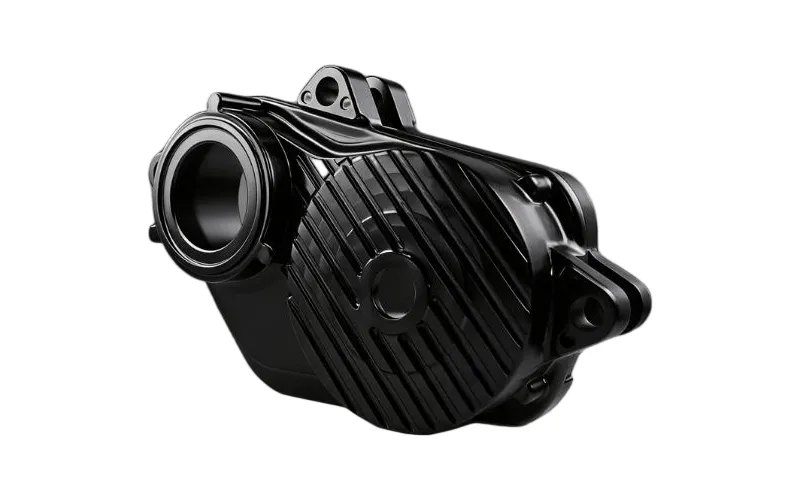
Electrophoresis
E-Coating Process Overview
E-coating is a finishing process that provides metal parts with a uniform, dense, and corrosion-resistant coating. It can cover complex inner cavities, welded areas, and corners more effectively than many traditional coating methods.
Customer Benefits
Strong corrosion protection
Salt spray resistance can reach 1,000 hours or moreUniform coating thickness
Helps reduce the impact on assembly and fitSuitable for mass production
Stable process with controllable costEnvironmentally friendly
Suitable for export-oriented manufacturing requirements
What Materials and Specifications Are Supported?
| Item | Description |
|---|---|
| Suitable Materials | Conductive metals such as steel, iron, aluminum alloy, and zinc alloy |
| Coating Thickness | 10–35 μm depending on requirement |
| Common Colors | Black, gray, bronze, transparent |
| Corrosion Resistance Level | Indoor 240h / outdoor 500h / marine-level 1000h (neutral salt spray test) |
Note: Bright colors such as red, blue, and green are usually not achieved by e-coating. If strong decorative colors are required, powder coating is usually a better choice.
Coating Thickness and Corrosion Resistance
| Thickness Level | Film Thickness (μm) | Salt Spray Resistance (Hours) | Typical Applications |
|---|---|---|---|
| Thin Coating | 10–15 | 120–240 | Indoor parts |
| Standard Coating | 15–25 | 240–500 | Home appliances, general industrial parts |
| Thick Coating | 25–35 | 500–1000+ | Automotive chassis parts, outdoor equipment |
Influence on Dimensions
Typical one-side coating build-up is about 0.010–0.035 mm
For threaded holes and critical fitting surfaces, masking or post-coating dimensional correction is recommended
For general appearance surfaces, the dimensional effect is usually small
Typical Applications
| Industry | Typical Parts |
|---|---|
| Automotive | Chassis parts, brackets, suspension components |
| Home Appliances | Refrigerator side panels, washing machine inner drums |
| Hardware | Hinges, locks, tools |
| Electronics | Heat sinks, shielding covers |
FAQ
Which is better, e-coating or spray painting?
It depends on the application.
E-coating provides better coverage in corners and hidden areas, with stronger corrosion resistance. Spray painting offers more color options and decorative flexibility.
Can e-coated parts be shipped directly?
Yes. After curing, the coating becomes a finished protective layer with good resistance to fingerprints and light scratches.
Can aluminum parts be e-coated?
Yes, they can. However, proper pretreatment is required, such as chemical conversion or phosphating, and the available colors are usually limited to transparent, dark, or black tones.
How should the requirement be specified?
A clear specification usually includes:
material → required salt spray hours → coating thickness → color → whether masking is needed for fitting areas
Conclusion
E-coating is an efficient way to turn metal parts into durable, corrosion-resistant finished products. It is especially suitable for projects that require reliable anti-corrosion performance, complex part geometry, and stable mass production.