
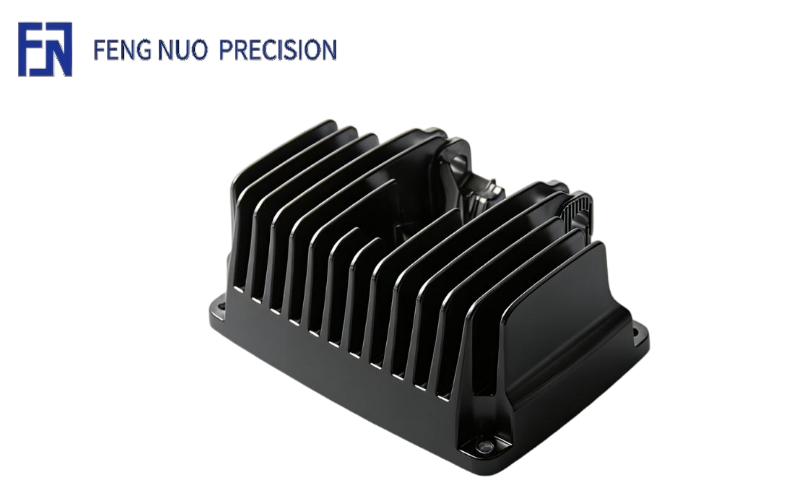
Surface Finishing Electrophoresis 1Aluminum UAV Engine Cooling Upper Cover with Electrophoretic Coat
In UAV and drone systems, thermal management is critical to ensuring stable engine performance, extended flight time, and reliable operation in variable environments. The engine cooling upper cover not only protects internal components but also supports airflow management and structural stability. For lightweight yet durable performance, aluminum alloy is widely used in UAV structural and thermal components.
Our aluminum UAV engine cooling upper covers with electrophoretic coating (E-coating) are engineered to combine precision machining with advanced surface treatment technology. As a professional manufacturing factory, we integrate CNC machining and controlled electrophoretic coating processes to achieve uniform surface protection, enhanced corrosion resistance, and long-term durability.
Electrophoretic coating provides consistent, high-adhesion coverage, making it particularly suitable for UAV components exposed to outdoor conditions, humidity, and temperature variation.
The Role of the Cooling Upper Cover in UAV Systems
The engine cooling upper cover serves multiple functions in UAV applications:
Protecting engine and cooling components
Supporting airflow guidance
Preventing debris intrusion
Enhancing structural rigidity
Providing mounting interfaces
Precise machining ensures that the cover aligns accurately with the engine housing and cooling modules. Ventilation slots and aerodynamic contours are carefully designed to maintain airflow efficiency without compromising strength.
Because UAV engines generate heat during prolonged operation, effective surface protection is necessary to prevent oxidation and environmental damage.
Aluminum Alloy as the Base Material
Aluminum alloy is selected for UAV engine cooling components due to its:
Lightweight properties
High strength-to-weight ratio
Excellent thermal conductivity
Corrosion resistance
Good machinability
Common alloys such as 6061 or similar aerospace-grade aluminum materials provide structural stability while minimizing weight—an essential factor for maximizing flight endurance.
Lightweight design directly contributes to improved battery efficiency and overall flight performance.
Electrophoretic Coating (E-Coating) Process Overview
Electrophoretic coating, also known as E-coating, is an advanced surface treatment process that applies a uniform protective film through electrochemical deposition.
The process typically includes:
Surface cleaning and degreasing
Chemical pretreatment (phosphating or similar preparation)
Immersion in electrophoretic coating bath
Application of electric current to deposit coating
Rinsing and curing in controlled temperature oven
Thickness and appearance inspection
Unlike conventional spraying, electrophoretic coating ensures uniform coverage even on complex geometries and internal cavities. This makes it particularly effective for UAV components with ventilation openings and intricate structures.
Advantages of Electrophoretic Coating for UAV Components
Electrophoretic coating offers several benefits for aluminum UAV engine covers:
Uniform coating thickness
Excellent corrosion resistance
Strong adhesion to aluminum surfaces
Improved impact resistance
Smooth and consistent surface appearance
Resistance to UV exposure and environmental stress
Because UAVs operate in outdoor environments, surface protection must withstand humidity, dust, and temperature fluctuations.
E-coating provides reliable long-term protection without significantly increasing weight.
Engineering Considerations for E-Coated Aluminum Covers
Producing high-quality electrophoretically coated aluminum parts requires careful process coordination.
Key considerations include:
1. Surface Preparation Quality
Proper pretreatment ensures strong coating adhesion.
2. Dimensional Control
Coating thickness must be considered during machining to maintain assembly fit.
3. Ventilation Feature Integrity
Airflow openings must remain dimensionally accurate after coating.
4. Thermal Stability
Curing processes must not distort thin-wall aluminum structures.
Controlled processing ensures consistent surface quality and structural integrity.
Other UAV Components Using Electrophoretic Coating
Electrophoretic coating is widely applied in UAV manufacturing beyond engine cooling covers, including:
Aluminum motor mounts
Structural frame connectors
Protective outer housings
Battery compartment covers
Landing gear components
Camera gimbal support structures
E-coating provides durable protection for lightweight aluminum parts used throughout drone systems.
Quality Control and Inspection
Our manufacturing process follows structured quality management systems including:
ISO 9001 quality standards
Coating thickness measurement
Adhesion testing
Salt spray corrosion testing (if required)
Visual surface inspection
Dimensional verification after coating
Consistent coating thickness and surface uniformity are carefully monitored to ensure batch stability.
Commitment to UAV Surface Protection Excellence
In UAV systems, durability and lightweight performance must work together. Our aluminum UAV engine cooling upper covers combine precision CNC machining with advanced electrophoretic coating technology to deliver both structural accuracy and reliable surface protection.
From prototype development to serial production, we focus on:
Accurate geometric control
Uniform E-coating application
Corrosion-resistant performance
Stable batch repeatability
Whether supporting commercial drone manufacturers, industrial UAV developers, or specialized aerial system integrators, our E-coated aluminum engine covers provide dependable protection and high-performance durability for advanced UAV applications.