
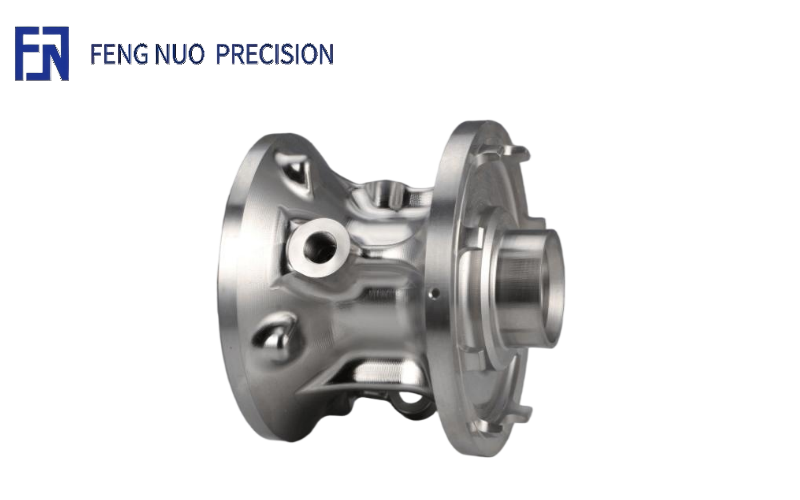
5-Axis CNC Machined Stainless Steel Components for Industrial Automation Systems
Industrial automation systems demand mechanical components that combine precision, durability, and long-term stability. From automated production lines and robotic assembly stations to precision packaging equipment and smart manufacturing platforms, stainless steel structural and functional parts play a critical role in maintaining system performance.
Our 5-axis CNC machined stainless steel automation components are engineered to meet the complex geometric and mechanical requirements of modern automation equipment. Designed for high positional accuracy, structural rigidity, and corrosion resistance, these components support consistent motion control, precise alignment, and reliable long-term operation.
Automation systems operate under continuous cycles, repetitive motion, and varying environmental conditions. Therefore, dimensional consistency and mechanical integrity are essential for minimizing downtime and maintaining productivity.
Why 5-Axis CNC Machining for Automation Components?
Automation parts frequently feature multi-angle surfaces, intersecting bores, complex contours, and integrated structural geometries. Traditional machining methods may require multiple setups, increasing alignment error and reducing efficiency.
5-axis CNC machining offers significant advantages:
Simultaneous multi-surface processing
Improved geometric accuracy
Reduced tolerance stack-up
Efficient machining of complex cavities
Enhanced concentricity between critical features
Higher production repeatability
For example, automation equipment often requires accurate alignment between linear guide mounts, bearing seats, and actuator interfaces. Single-setup machining improves positional precision between these key elements.
Stainless Steel in Automation Applications
Stainless steel is widely selected in industrial automation due to its mechanical strength, wear resistance, and corrosion resistance.
Common stainless steel grades include:
SUS304 for general automation structures
SUS316 for chemically exposed environments
SUS420 for wear-resistant mechanical parts
High-strength stainless alloys for load-bearing components
Automation environments may involve lubricants, coolants, moisture, or chemical exposure. Stainless steel ensures long-term durability under these conditions.
In addition, stainless steel components maintain dimensional stability under repeated mechanical load cycles.
Manufacturing Standards in Industrial Automation
Automation equipment manufacturers require reliable process control and consistent quality.
Our machining processes follow structured quality management systems including:
ISO 9001 quality standards
First Article Inspection (FAI)
In-process monitoring
Geometric tolerance inspection
Batch traceability documentation
Dimensional verification is conducted using coordinate measuring machines (CMM), precision micrometers, and calibrated gauges. Key features such as bore alignment, flatness, perpendicularity, and positional tolerances are carefully measured.
High repeatability across batches ensures compatibility in modular automation systems.
Typical Stainless Steel Automation Components We Manufacture
Our 5-axis CNC capabilities support a wide range of automation components, including:
Linear motion system mounts
Actuator interface blocks
Precision guide rail supports
Rotary positioning components
Sensor mounting brackets
Pneumatic system bodies
Automated fixture plates
Structural reinforcement connectors
Many of these parts require complex intersecting geometries and tight tolerance control to ensure proper system integration.
Engineering Considerations for Automation Parts
Producing stainless steel components for automation equipment requires careful control of several technical factors:
1. Dimensional Stability
Accurate geometry ensures precise motion control and repeatable positioning.
2. Wear Resistance
Automation systems often operate continuously. Material selection and surface finishing must support long service life.
3. Structural Rigidity
Components must withstand repetitive dynamic loads without deformation.
4. Surface Integrity
Smooth surface finishes reduce friction and improve assembly performance.
Optimized cutting strategies are applied during machining to manage heat generation and minimize work hardening in stainless steel.
Surface Finishing and Post-Processing
Depending on the application, stainless steel automation components may undergo additional finishing treatments such as:
Passivation to enhance corrosion resistance
Precision polishing for sliding interfaces
Heat treatment for improved hardness
Laser marking for identification
Deburring and edge conditioning
Surface treatments contribute to durability, safety, and reliable assembly.
Additional CNC Capabilities for Automation Industry
Beyond stainless steel structural parts, automation CNC machining frequently includes:
Aluminum lightweight frames
Hardened steel transmission parts
Precision shafts and couplings
Custom tooling and fixture components
Robotic interface brackets
Modular mounting systems
5-axis CNC machining is particularly beneficial for parts requiring multi-surface accuracy and complex geometries in a single setup.
Commitment to Precision Automation Manufacturing
Industrial automation systems depend on precise mechanical alignment and long-term reliability. Our 5-axis CNC machining technology enables the production of stainless steel components that meet the performance requirements of advanced automation equipment.
From prototype development to controlled production runs, we emphasize dimensional accuracy, consistent material performance, and structured quality management.
Whether supporting robotic assembly cells, packaging systems, precision motion platforms, or smart manufacturing solutions, our precision-machined stainless steel automation components deliver reliability and performance in demanding industrial environments.