
5 Axis CNC Lead Time: What Affects Delivery Speed?
Introduction
5-axis CNC machining lead time typically ranges from 3–7 days for simple parts to 10–25+ days for complex components, depending on geometry, material, and process requirements.
Fast delivery is not determined by machine speed alone. It depends on programming complexity, setup strategy, and production scheduling.
This range is based on typical CNC machining lead time benchmarks and production data.
Key Takeaways
Typical lead time: 3–7 days (simple parts), 10–25+ days (complex parts)
Programming and setup often take 30%–50% of total lead time (in low-volume, high-complexity jobs)
Complex geometry and toolpath simulation are the main causes of delay
Reducing setups can significantly shorten delivery time
Lead time can be reduced by 20%–50% with design and process optimization
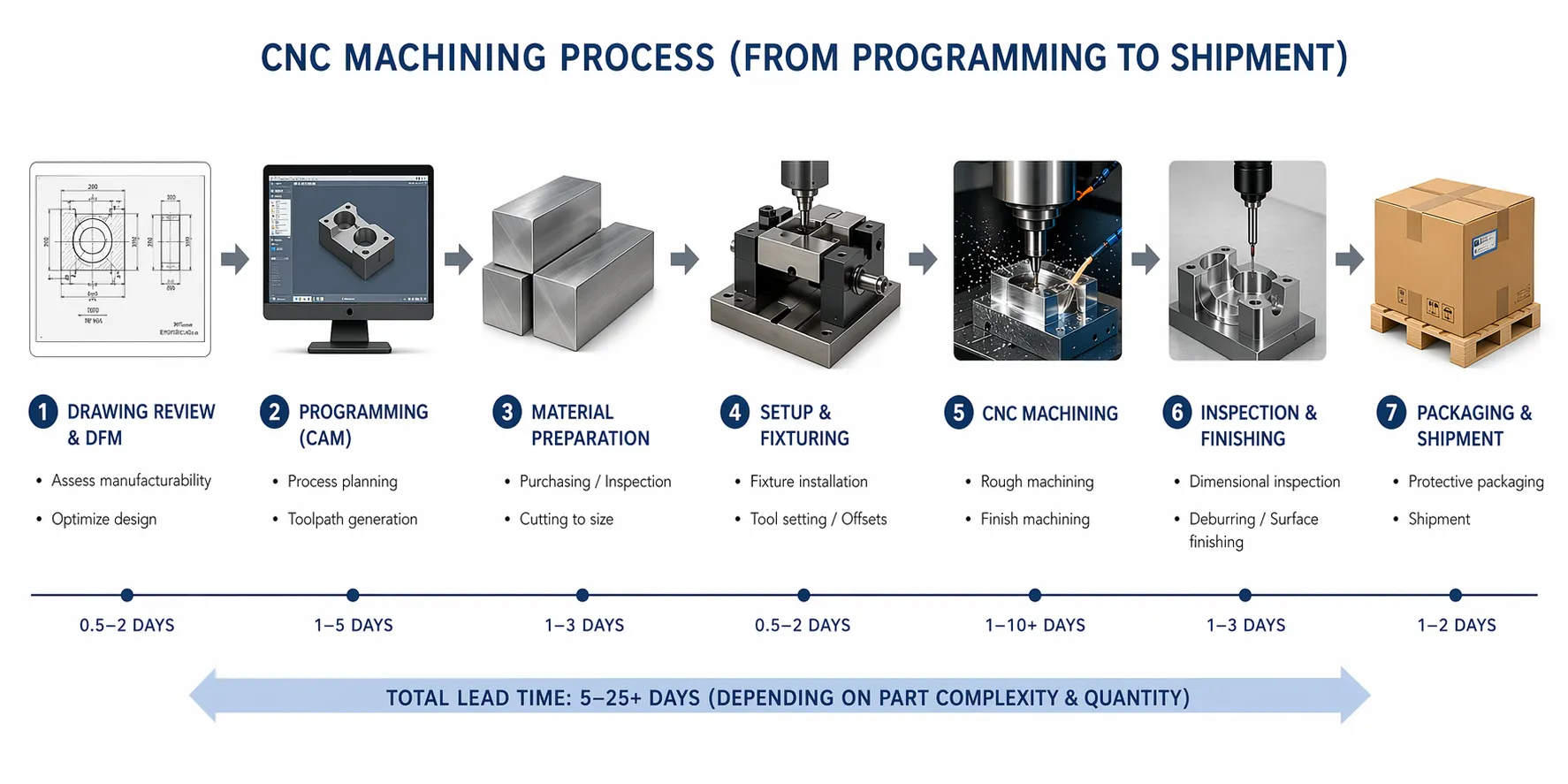
Typical 5 Axis CNC Lead Time Breakdown
Lead time consists of multiple stages, not just machining.
Standard Process Timeline
| Stage | Time Range |
|---|---|
| Drawing review & DFM | 0.5–2 days |
| Programming (CAM) | 1–5 days |
| Material preparation | 1–3 days |
| Setup & fixturing | 0.5–2 days |
| Machining | 1–10+ days |
| Inspection & finishing | 1–3 days |
For simple parts, machining dominates; for complex parts, programming and setup become the main bottlenecks.
What Slows Down 5 Axis CNC Lead Time
Delays are usually caused by process complexity, not machine availability.
1. Complex Programming and Toolpaths
Multi-axis toolpaths require simulation and verification
Collision avoidance increases programming time
Simple parts may require around 2 days, while complex multi-surface parts may require up to 5 days.
2. Multiple Setups and Fixturing
Custom fixtures increase preparation time
Repositioning adds alignment effort
Typical impact:
Simple setup → ~0.5 day
Complex fixture → up to 1.5 days
3. Difficult Materials
Cutting speed and tool life vary significantly
For example, aluminum allows faster machining, while titanium can significantly extend machining time.
→ Machining time may increase by 30%–100% depending on material.
4. Tight Tolerance and Inspection
More inspection steps required
Increased measurement cycles
→ Inspection time may add 1–2 days.
What Speeds Up Lead Time (Most Important)
Lead time improvement depends on reducing complexity before machining starts.
1. Reduce Setup Count
Design parts to be machined in ≤2 setups
Action: Ask your supplier — can this part be completed in fewer setups?
2. Simplify Geometry
Avoid unnecessary curved surfaces
Reduce deep cavities
Action: Ask — can complex features be simplified?
3. Improve Tool Accessibility
Avoid deep narrow pockets
Reduce tool overhang
Action: Ask — will this geometry require special tooling?
4. Optimize Tolerance Requirements
Apply tight tolerance only where needed
Action: Ask — which tolerances are function-critical?
5. Plan Early
Confirm manufacturability before finalizing design
Action: Ask — can this design be optimized before production?
Real Case: Reducing Lead Time by 40%
Scenario
A customer required a complex aluminum part with multiple angled features.
Initial Situation
Full 5-axis machining
4 setups required
Complex toolpaths
Problem
Programming took 5 days
Setup required 2 days
Total lead time: 18 days
Optimization
Reduced setups from 4 → 2
Simplified geometry
Improved tool access
Result
| Metric | Before | After |
|---|---|---|
| Programming Time | 5 days | 2 days |
| Setup Time | 2 days | 1 day |
| Total Lead Time | 18 days | 10–11 days |
| Reduction | — | ~40% |
Without optimization, lead time would likely remain above 15–18 days due to programming and setup complexity.
How Fast Can You Get Parts (Rush Orders)
Urgent orders are possible but limited by process constraints.
Typical Rush Lead Time
Simple parts → 2–4 days
Medium complexity → 5–10 days
Complex 5-axis parts → limited acceleration
Even under rush conditions, total lead time is rarely reduced by more than 30%–50% due to process constraints.
What Happens If Lead Time Is Misjudged
Incorrect planning leads to downstream issues.
Common Consequences
Delayed product launch
Increased cost due to urgent production
Multiple revisions due to rushed programming
Lead time may increase by 20%–50% due to rework, redesign, or production rescheduling.
FAQ
Is 5-axis always slower than 3-axis?
No. It is faster for complex parts but slower for simple ones.
What is the biggest delay factor?
Programming and setup.
Can all parts be rushed?
No. Complexity limits acceleration.

If your project is urgent, feel free to contact us — we will provide a clear production lead time within 24 hours.