
What Is Polyurethane Casting? A Buyer's Guide for Prototypes and Low-Volume Production
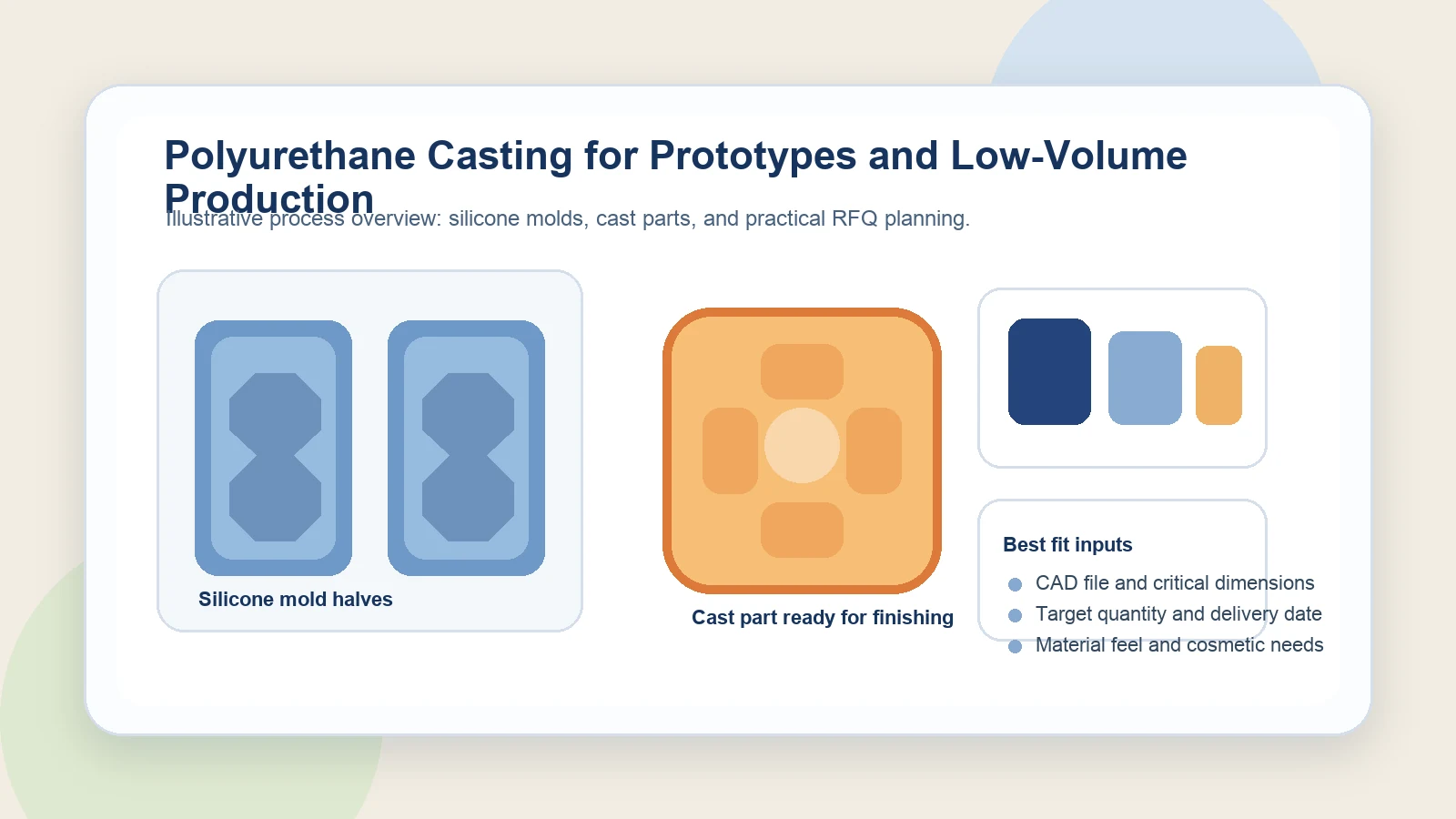
Quick Answer: What Is Polyurethane Casting and When Should You Use It?
Polyurethane casting is a low-volume manufacturing process that uses silicone molds and liquid polyurethane resin to create plastic-like parts without the tooling cost and long setup time of injection molding. It is commonly used for functional prototypes, bridge production, pilot runs, and small batches where buyers need better surface finish and more production-like behavior than many 3D-printed parts can provide.
For procurement teams and engineers, polyurethane casting is most useful when the project is too small for hard tooling, too cosmetic for rough prototype methods, or too complex to machine efficiently from solid plastic. It is especially practical when the part geometry includes undercuts, cosmetic surfaces, flexible features, or multiple finishing requirements.
In most projects, the process starts with a master pattern made by CNC machining or 3D printing. That pattern is used to create a silicone mold, and the mold is then used to cast polyurethane parts. The result is a practical middle ground between 3D printing, CNC machining, and high-volume injection molding.
What Is Polyurethane Casting?
Polyurethane casting, also called urethane casting or vacuum casting, is a mold-based process that produces plastic-like parts from two-part polyurethane resins. Unlike injection molding, which relies on rigid metal tooling, polyurethane casting uses flexible silicone molds made from a master pattern. That lower tooling barrier is why the process fits prototype and low-volume programs so well.
The term vacuum casting is often used because the resin is frequently degassed or poured under vacuum to reduce trapped air and improve surface quality. In practice, buyers should focus less on the label and more on the project fit: silicone tooling, limited mold life, low-to-medium volume, and strong cosmetic flexibility.
Typical use cases include:
Functional prototypes that need better appearance and more realistic assembly behavior than rough concept models
Pilot runs and bridge production while injection mold tooling is still being reviewed or manufactured
Low-volume orders where part demand is too small to justify hard tooling
Cosmetic housings and covers that need paintable, smooth, presentation-ready surfaces
Complex shapes with undercuts, snap details, or molded-style geometry that would be inefficient to machine
How Polyurethane Casting Works
A typical polyurethane casting workflow has five practical stages:
1. Build the master pattern.
The master defines the final geometry and surface quality. Depending on the tolerance, finish, and schedule, it is usually produced by CNC machining or 3D printing. Any sanding, polishing, or texture work applied to the master will influence the final cast surface.
2. Make the silicone mold.
The master is set in a mold box and surrounded with liquid silicone. After curing, the mold is cut open and the master is removed, leaving a cavity that reproduces the part geometry. Flexible silicone is a major advantage because it can release shapes that would require far more complex metal tooling in injection molding.
3. Mix and cast the resin.
A selected polyurethane resin is mixed with its curing system and poured into the silicone mold. For many functional or cosmetic parts, the process includes vacuum support to reduce bubbles and improve consistency.
4. Cure, demold, and finish.
After curing, the part is removed and any gate marks, flash, or surface imperfections are finished. If the project requires painting, texture, inserts, pad printing, or assembly, those steps are added after demolding.
5. Repeat until mold life is reached.
A silicone mold usually supports only a limited number of good parts before wear affects surface quality or dimensional repeatability. For that reason, the supplier may need multiple molds when volume increases.
Polyurethane Casting vs Injection Molding vs CNC Machining
Buyers often evaluate polyurethane casting against injection molding and CNC machining in the same RFQ cycle. The right choice usually depends on tooling economics, geometry, finish requirements, and quantity.
Choose polyurethane casting when:
You need roughly tens to a few hundred plastic-like parts, want a low tooling barrier, and need a better cosmetic result than a rough prototype method can offer.
Choose injection molding when:
You expect sustained higher volume, require true thermoplastic production material, and can justify the cost and lead time of hard tooling.
Choose CNC machining when:
You need machined metals, engineering plastics with tighter dimensional control, or very low quantities where mold making would not be efficient.
From a buyer's perspective, the most important trade-offs are straightforward:
Tooling: polyurethane casting uses low-cost silicone tooling, injection molding uses expensive hard tooling, and CNC machining uses no mold at all.
Volume: polyurethane casting fits prototype and low-volume demand, injection molding fits repeated higher-volume production, and CNC machining fits very low volume or high-precision part requirements.
Material realism: cast polyurethane can simulate many production plastics, but it is still not identical to every injection-grade thermoplastic.
Geometry and finish: polyurethane casting performs well for molded-style shapes and cosmetic surfaces, while CNC machining is limited by tool access and injection molding is limited by tooling rules.
Lead time: polyurethane casting is usually faster to first parts than injection molding, but slower than a very simple machined or printed prototype.
Need help choosing the right process?
Send the CAD file, target quantity, cosmetic requirement, and delivery date through Fengnuo's contact page. That gives the engineering team enough context to compare polyurethane casting, machining, and other routes before quoting.
When Polyurethane Casting Is the Best Fit
Polyurethane casting is usually the strongest option when several of the following conditions apply:
The quantity is too low for hard tooling. If you need a few dozen or a few hundred parts, silicone tooling is often easier to justify than a steel or aluminum mold.
You need production-like appearance. For housings, covers, enclosures, and consumer-facing parts, polyurethane casting typically delivers a better surface than many quick prototype methods.
The design is still evolving. Silicone molds and master patterns are easier to revise than production injection tooling.
You need molded-style geometry. Undercuts, snaps, curves, and enclosed features may be more practical than machining them from solid material.
The timeline is tighter than an injection-mold program allows. Buyers often use polyurethane casting to bridge the gap while final production tooling is still under review.
It is less suitable when the project needs true thermoplastic production material, very high annual volume, very high heat resistance, or a strict regulatory material requirement that can only be met by a confirmed production-grade resin.
Common Material Options and What Buyers Should Check
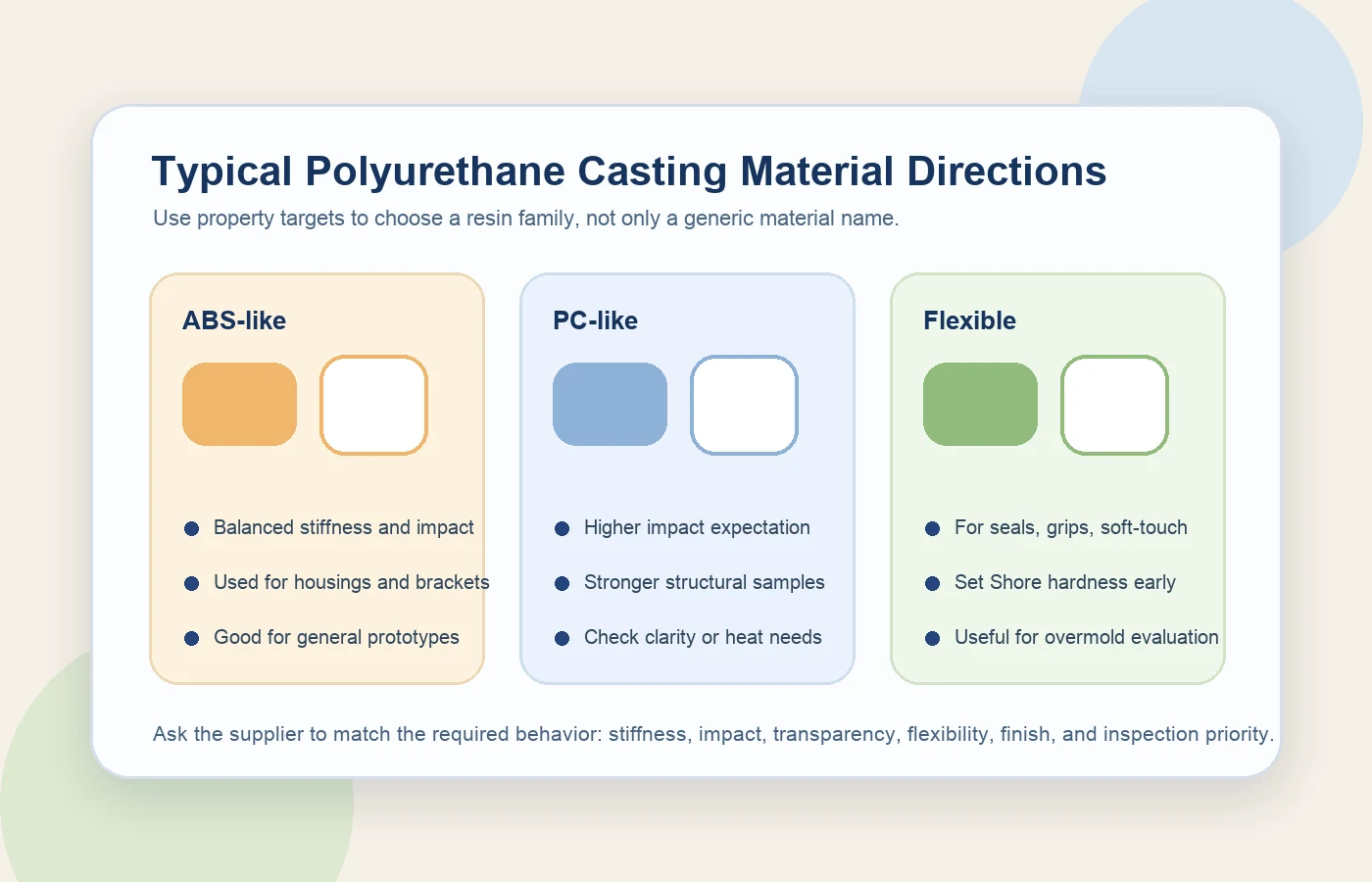
Polyurethane casting materials are usually selected by performance target rather than by exact polymer family. Most suppliers offer resin options intended to simulate common engineering plastics. The key is to confirm which property matters most in your application.
ABS-like grades are often chosen for housings, brackets, and general prototype parts that need balanced stiffness and impact resistance.
Polycarbonate-like grades are used when buyers need stronger impact behavior or somewhat higher heat performance than a general-purpose resin offers.
Polypropylene-like grades may be relevant when flexibility, chemical resistance, or living-hinge behavior is part of the design intent.
Nylon-like grades can support stronger mechanical prototype parts where wear or structural behavior matters.
Flexible elastomeric grades are useful for soft-touch, sealing, grip, or overmold-style applications.
Transparent or translucent grades may be used for covers, lenses, and visual demonstration parts, although buyers should confirm the actual clarity level and finishing plan.
Instead of asking only for "the strongest resin," buyers usually get better results by specifying the real requirement: stiffness, impact resistance, Shore hardness, transparency, paintability, cosmetic finish, or operating environment. That helps the supplier narrow the resin choice more effectively.
Cost Drivers in Polyurethane Casting
Polyurethane casting is cost-effective for the right quantity range, but the quoted price still depends on a few major variables:
Master pattern method: CNC-machined masters can improve accuracy and surface quality, while 3D-printed masters may reduce setup cost for early-stage programs.
Part size and geometry: Larger parts, more complex parting lines, deeper undercuts, and cosmetic features usually increase mold and finishing effort.
Quantity: Unit cost improves as tooling cost is spread across more parts, but silicone mold life is limited, so higher quantities may require additional molds.
Resin choice: Higher-performance or specialty resin grades usually add cost.
Cosmetic work: Painting, texture matching, inserts, assembly, and special packaging all add labor and schedule complexity.
Inspection scope: Dimensional reports, special inspection points, or approval samples increase review time before shipment.
If the project is in the 10 to 50 part range and the geometry is molded-style rather than block-like, polyurethane casting is often more economical than machining each part from plastic stock. If the design is still changing, it can also reduce the financial risk of committing too early to production tooling.
What Affects Lead Time
Lead time in polyurethane casting is usually shorter than injection molding because silicone tooling is faster to make. Even so, buyers should not assume every project follows the same schedule. The main timing drivers are:
Master readiness: if the CAD is incomplete, the drawing is unclear, or the master still needs revision, the whole program slows down.
Mold complexity: large parts, deep undercuts, and fragile cavity features may require extra mold design and finishing care.
Material and finish selection: custom color, painting, clear finishing, inserts, and assembly steps extend the schedule.
Quantity and mold count: more parts may mean more mold cycles or multiple molds.
Inspection expectations: approval samples, appearance checks, and dimensional verification can add review time before shipment.
A practical buyer approach is to provide the target delivery date upfront and ask the supplier to identify the likely schedule bottleneck. That is usually more useful than asking for a generic "fastest lead time."
Design Tips That Prevent Delays and Rework
Polyurethane casting is forgiving in some ways, but avoidable design issues still cost time and money. The following checks help buyers get more stable results:
Keep wall sections reasonably consistent. Sudden thickness changes can increase curing and appearance variation.
Review undercuts early. Silicone molds can handle them, but deep undercuts may still require more mold cutting and manual finishing.
Think about the parting line. A poor parting-line location can create unnecessary cleanup on cosmetic faces.
Define the cosmetic standard. If one face must look presentation-ready, state that clearly in the RFQ instead of assuming the supplier will guess.
Specify only the tolerances that matter. A 2D drawing with critical dimensions helps the supplier focus inspection effort where it affects function.
What to Include in an RFQ
A polyurethane casting RFQ moves much faster when the supplier receives enough information to choose the resin, mold strategy, and finishing route correctly. Send:
3D CAD data such as STEP or STL
A 2D drawing for any critical dimensions, fit points, or inspection requirements
Required quantity for the first order and expected follow-up quantity if known
Target material behavior such as stiffness, flexibility, transparency, or impact resistance
Color, paint, surface finish, texture, or cosmetic-face requirements
Any inserts, hardware, assembly, or post-processing requirements
Your target delivery date and approval process
If you are still comparing process options, the following pages are useful related resources:
Ready for a polyurethane casting review?
Send the CAD file, quantity, preferred finish, and target delivery date through the RFQ contact page. That gives Fengnuo enough detail to review resin fit, mold strategy, and finishing risk before quoting.
How Fengnuo Can Support This Type of Project
Based on Fengnuo's public service and company pages, the company positions polyurethane casting as part of a broader custom manufacturing workflow that also includes CNC machining, 3D printing, sheet metal fabrication, and finishing support. That combination matters because many polyurethane casting jobs still depend on a good master pattern, practical DFM discussion, and coordinated finishing after demolding.
The public polyurethane casting service information indicates support for silicone mold creation, master pattern preparation, multiple resin-style options, finishing work, and dimensional inspection. For buyers, that means one supplier can help review whether polyurethane casting is the right route or whether the design would be better served by another process in the same sourcing cycle.
FAQ
What is the difference between polyurethane casting and vacuum casting?
In many quoting conversations, the terms are used almost interchangeably. Vacuum casting usually refers to the use of vacuum during the casting process to reduce bubbles, while polyurethane casting describes the broader low-volume resin casting approach.
How many parts can one silicone mold produce?
The answer depends on part geometry, resin choice, and cosmetic expectations, but silicone tooling has a limited life and should be treated as prototype or low-volume tooling rather than permanent production tooling.
Is polyurethane casting good for functional prototypes?
Yes, especially when you need a part that looks and behaves more like a production plastic component than a basic concept model. The right resin choice matters, so functional requirements should be stated clearly in the RFQ.
Can polyurethane casting handle undercuts?
Yes, silicone molds are flexible enough to release many undercut features that would be difficult in rigid tooling. That said, deep or delicate undercuts can still increase mold-cutting and finishing effort.
What files should I send for a quote?
Send the 3D file, quantity, target delivery date, finish requirements, and any critical dimensions or inspection expectations. The more clearly you define function and appearance, the more useful the quote review will be.