
CNC Machining Inspection Reports: What Buyers Should Request Before Shipment
A CNC machining inspection report is useful only when it reflects the drawing revision, critical features, quantity, and acceptance rules that the buyer and supplier agreed before production. Asking for “a quality report” after the parts are finished often creates confusion because routine shop inspection, a dimensional report, a first-article layout, and material or finishing records are different deliverables.
The practical approach is to define the inspection scope during quotation. Buyers should identify what controls function, what evidence must accompany the shipment, and who can approve a deviation. The supplier can then plan measurement access, gauges, fixtures, reporting time, and cost before machining begins.
Quick Answer: What Inspection Report Should a CNC Buyer Request?
Request the level of evidence that matches the part risk. A simple noncritical component may need standard final inspection and a basic record. A new precision assembly may need a documented report for critical dimensions. A complex or revised part may justify a first-article or full-layout report before the remaining batch is released. Material, finishing, traceability, or special-process records should be listed separately when the project requires them.
Do not assume every document is included in a standard machining price. Put the required report, format, revision, features, sampling rule, and delivery timing in the RFQ and purchase order.
Start With the Drawing and Critical Characteristics
The inspection plan should begin with the approved 2D drawing, not with a generic checklist. Confirm the part number, drawing revision, units, material, finish, datums, tolerances, and notes. Then identify the characteristics that determine whether the part will assemble or function.
mating diameters, bearing or seal fits, and alignment features;
datum relationships and geometric controls;
threads, inserts, holes, and minimum engagement requirements;
flatness, parallelism, perpendicularity, or position where function requires it;
surface finish, coating, masking, and post-finish dimensions;
cosmetic zones, sharp-edge controls, and damage-sensitive surfaces.
This prevents the report from becoming a long list of low-value measurements while an important interface is missed. It also helps the supplier choose an appropriate measurement method. Fengnuo's guide to inspecting CNC machining tolerances explains why the instrument and setup should match the feature being evaluated.
Four Common Levels of Inspection Evidence
1. Routine Shop and Final Inspection
The supplier checks the part during machining and before release using its normal process controls. This may be appropriate for established, lower-risk work, but the buyer should still confirm what evidence will be retained and whether a document will be supplied with the order.
2. Critical-Dimension Inspection Report
A documented report lists the agreed critical characteristics and recorded results for the selected parts. This is often more useful than requesting every drawing dimension when the buyer mainly needs evidence for assembly, sealing, motion, or another functional interface.
3. First-Article or Full-Layout Report
For a new design, major revision, new process route, or higher-risk component, the buyer may request a first manufactured part or selected sample to be checked against the drawing before the remaining quantity is released. The exact format and scope must be agreed. A general first-article or full-layout report should not be represented as compliance with a named industry reporting standard unless that standard is specifically required and supported.
4. Supporting Material, Finish, and Traceability Records
Some orders require material records, heat or batch traceability, finishing records, hardness results, or other project-specific evidence. These documents are separate from dimensional inspection. State the exact requirement, acceptable source, and whether document review is required before shipment.
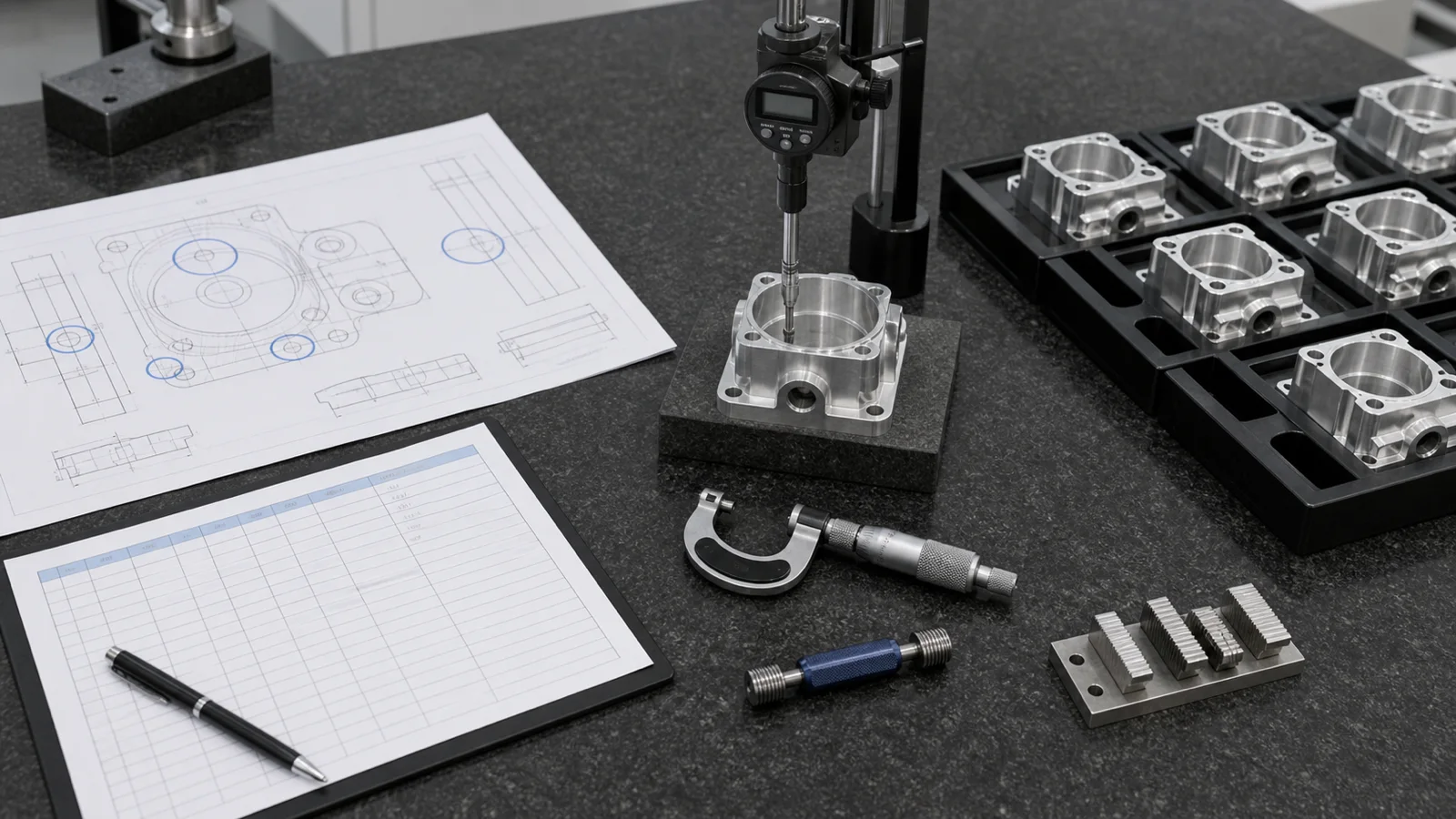
What a Useful Dimensional Report Should Contain
A report must allow the buyer to connect each result to the correct part and requirement. Depending on the project, useful fields include:
supplier, customer, part number, and drawing revision;
order, lot, batch, or sample identification;
characteristic number linked to the drawing;
nominal requirement and permitted tolerance;
measured result and acceptance status;
measurement method or instrument where relevant;
inspection date and responsible approval;
approved deviation or disposition reference, if applicable.
The buyer should review a sample report format before the first order if the internal receiving team or customer has specific requirements. A readable report delivered on time is more valuable than a large document that cannot be traced to the drawing.
Sampling or 100% Inspection?
Not every feature on every part requires the same inspection frequency. Sampling may be suitable when the process is stable and the project risk allows it. A buyer may request 100% inspection for selected critical characteristics when failure would create significant assembly, safety, sealing, or downstream cost risk.
The decision should consider quantity, feature importance, measurement repeatability, process capability, part value, and the cost of a nonconforming part reaching the next operation. Avoid writing “100% inspection” without stating which features are included. Measuring every characteristic on every part can add substantial handling and reporting work while still failing to focus on the real risk.
Features That Need More Than a Caliper Reading
Some drawing requirements depend heavily on setup and method. Datum-based geometric controls require a measurement strategy that represents the intended functional reference. Threads may require appropriate plug, ring, pitch, or optical checks rather than a diameter reading alone. Surface finish, coating thickness, hardness, and cosmetic acceptance also need their own defined method and criteria.
Ask the supplier how difficult features will be accessed and measured before approving the quotation. The public quality control and inspection page outlines Fengnuo's general inspection workflow, while the exact instrument, frequency, and documentation remain project-specific.
How to Handle Deviations and Nonconforming Results
An out-of-tolerance result should not disappear from the report or be accepted informally. Define who may review the condition, what functional evidence is needed, and whether written buyer approval is required before rework, use-as-is acceptance, replacement, or shipment.
Any approved deviation should identify the affected part, characteristic, quantity, and revision. This protects both parties and prevents an exception on one batch from becoming an unintended rule for future orders.
Pre-Shipment Inspection Report Review
Before approving shipment, confirm:
the report matches the current drawing revision and order quantity;
all agreed critical characteristics appear in the report;
sample or serial identification is clear;
results are complete, legible, and within the agreed limits;
material, finish, and traceability records are included when required;
deviations, rework, or substitutions have written disposition;
parts are protected and identified for shipment.
Inspection planning should also be part of the quotation package. The guide to getting an accurate CNC machining quotation explains why drawings, critical requirements, finishing, quantity, and documentation should be defined together.
Inspection Report Red Flags
the report has no drawing revision or part identification;
results are shown only as “OK” with no agreed measurement data where data was required;
critical features are absent while easy dimensions dominate the report;
the sample quantity or selection method is unclear;
a result is outside tolerance without a disposition reference;
the report format changes after production without buyer agreement;
certificates or traceability are promised verbally but not listed in the order.
How Fengnuo Supports Project-Specific Inspection
Fengnuo provides custom CNC machining services under an ISO 9001 quality management system. Inspection planning can be reviewed with the drawing, material, quantity, finishing, critical characteristics, and buyer documentation needs.
Because report scope differs by project, the best time to define it is before quotation approval. This allows measurement access, fixtures, special gauges, sampling, reporting, and release responsibilities to be considered in the manufacturing plan.
Need an Inspection Scope Review?
Send your drawing, quantity, critical features, required report format, material or finish records, and any traceability needs. Fengnuo will review what should be measured and documented before shipment.
FAQ
Is a dimensional report included with every CNC order?
Do not assume it is included. Routine inspection and a buyer-deliverable report are different scopes. State the required features, sample quantity, format, and delivery timing in the RFQ.
Should every drawing dimension appear in the report?
It depends on project risk and the agreed report level. A critical-dimension report may focus on functional features, while a first-article or full-layout review may cover a broader drawing scope.
Does first-article inspection mean AS9102 compliance?
No. A supplier may perform a project-specific first-article or full-layout inspection without claiming compliance with a named industry format. If a specific standard is required, state it during quotation and verify support.
When should buyers request 100% inspection?
Consider it for selected characteristics when the risk of a missed defect justifies the extra inspection. Define exactly which features require 100% inspection instead of applying the phrase to the entire drawing without a risk basis.