
5 Axis CNC Machining Services: Cost, Capabilities & When to Use It
Introduction
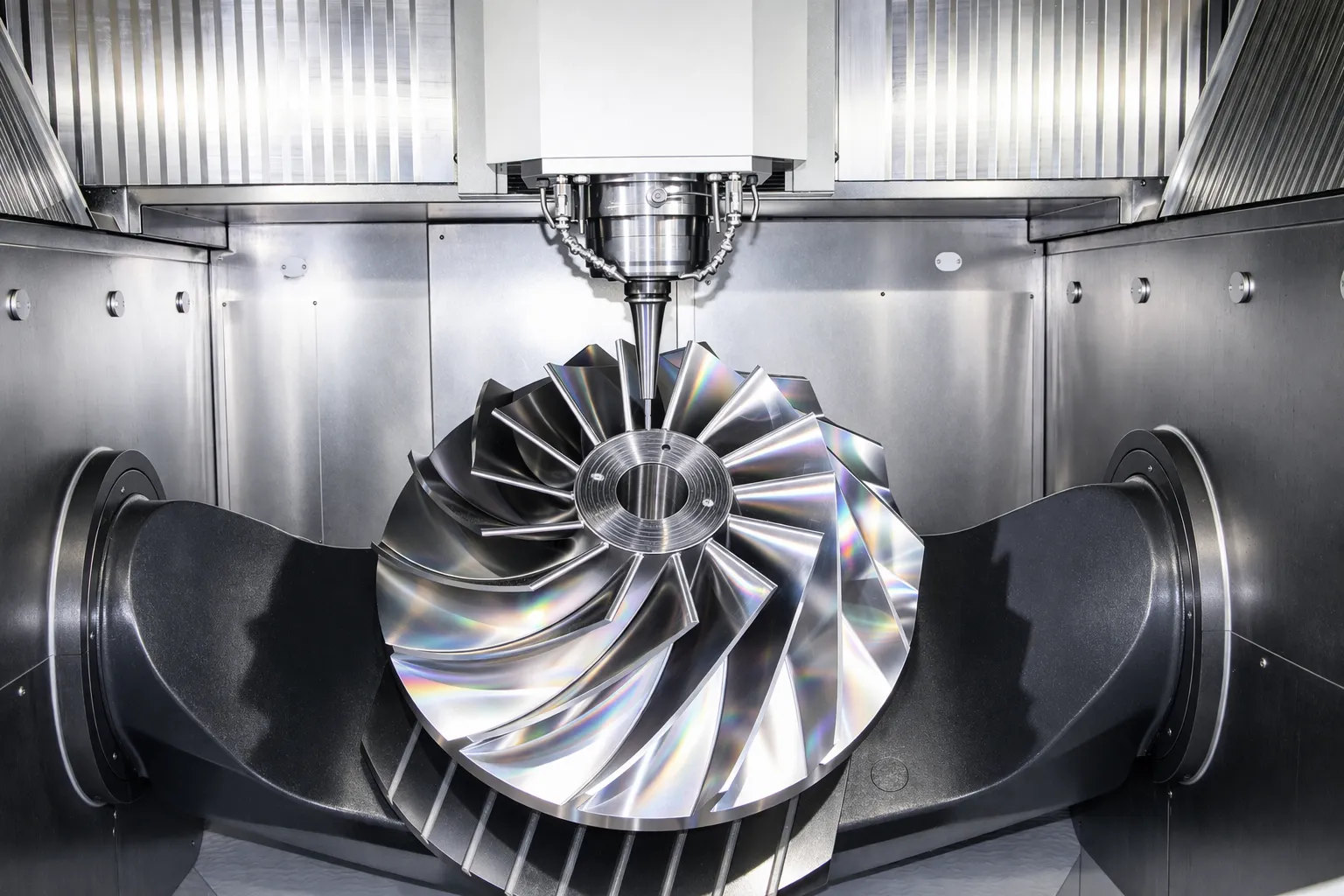
You should use 5-axis CNC machining only when your part requires multi-direction machining, complex curved surfaces, or tight positional accuracy that cannot be achieved within 2–3 setups.
If your part can be completed with fewer setups using 3-axis or 3+2 machining, 5-axis will usually increase cost without improving results.
Key Takeaways
5-axis machining is necessary when multiple setups would cause tolerance misalignment or unstable quality (typically >3 setups)
Total cost can be lower than 3-axis when setup count is high and geometry prevents stable fixturing
Cost typically increases by 30%–80% (when setups ≤2 and no complex surfaces are involved)
3+2 machining is often the best option when indexed positioning can access all features
The real decision factor is setup count + geometry accessibility, not visual complexity
When Do You Actually Need 5 Axis CNC Machining?
5-axis machining is required when multiple setups would introduce alignment errors, long lead times, or inconsistent quality.
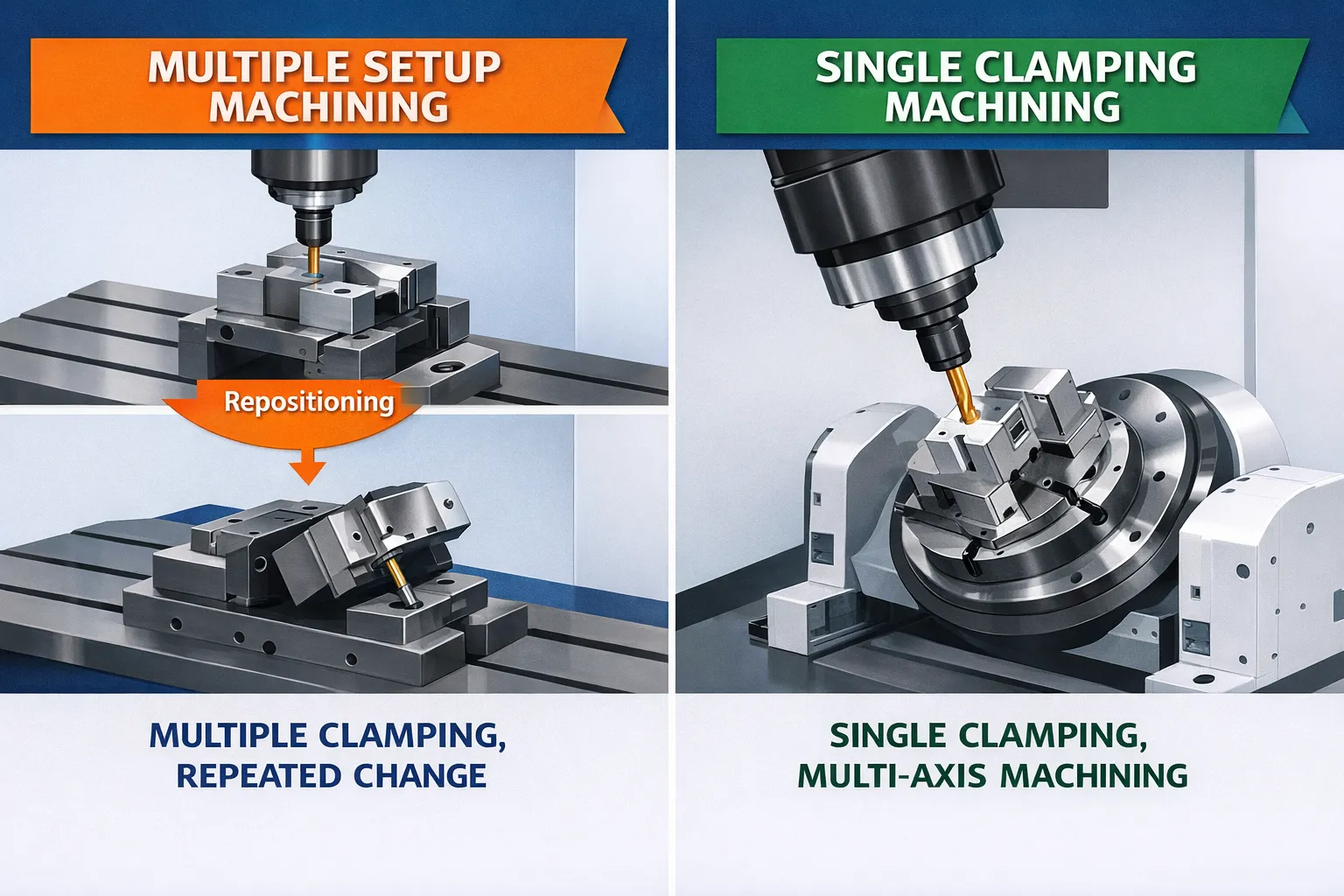
Why Setup Count Matters
Each additional setup introduces a new reference alignment.
1st setup → baseline accuracy
2nd setup → small positional deviation introduced
3rd–4th setup → tolerance stack-up becomes difficult to control
In practical terms:
Every re-clamping step adds fixture error + datum transfer error
These errors accumulate, especially in multi-face or high-precision parts
Typical Scenarios
Complex curved surfaces (impellers, turbine blades)
Multi-face machining with tight positional tolerance
Deep cavities with limited tool access
Parts requiring single-setup accuracy across multiple features
When You Should NOT Use 5 Axis (Critical)
Do not use 5-axis machining if your part can be completed with standard machining strategies without affecting quality or lead time.
Clear Conditions Where 5 Axis Is Unnecessary
Machining faces ≤ 3
Tolerance requirement > ±0.05 mm
No continuous curved surfaces
Features accessible with standard tool directions
High-volume production where fixtures can stabilize accuracy
Practical Impact
| Factor | Impact if Using 5 Axis Unnecessarily |
|---|---|
| Cost | Higher programming and machine cost |
| Lead time | Longer preparation time |
| Risk | Increased programming complexity |
| Value | No measurable improvement |
What 5 Axis CNC Machining Actually Changes
Reducing setups directly reduces cumulative positioning error, because all critical features are machined under a single coordinate system.
Reducing manual repositioning lowers operator dependency, which in turn decreases variability and production risk, especially in batch manufacturing.
3 Axis vs 3+2 vs 5 Axis: Decision Logic
Most parts do not require full 5-axis machining — the choice should be based on setup count and geometry accessibility, not machine capability.
Decision Threshold (Core)
| Condition | Recommendation |
|---|---|
| ≤ 3 setups required | Do NOT use 5-axis |
| Indexed positioning sufficient | Use 3+2 |
| Continuous multi-surface machining required | Use 5-axis |
| Complex curved geometry | Use 5-axis |
Real Case: When 5 Axis Became Necessary
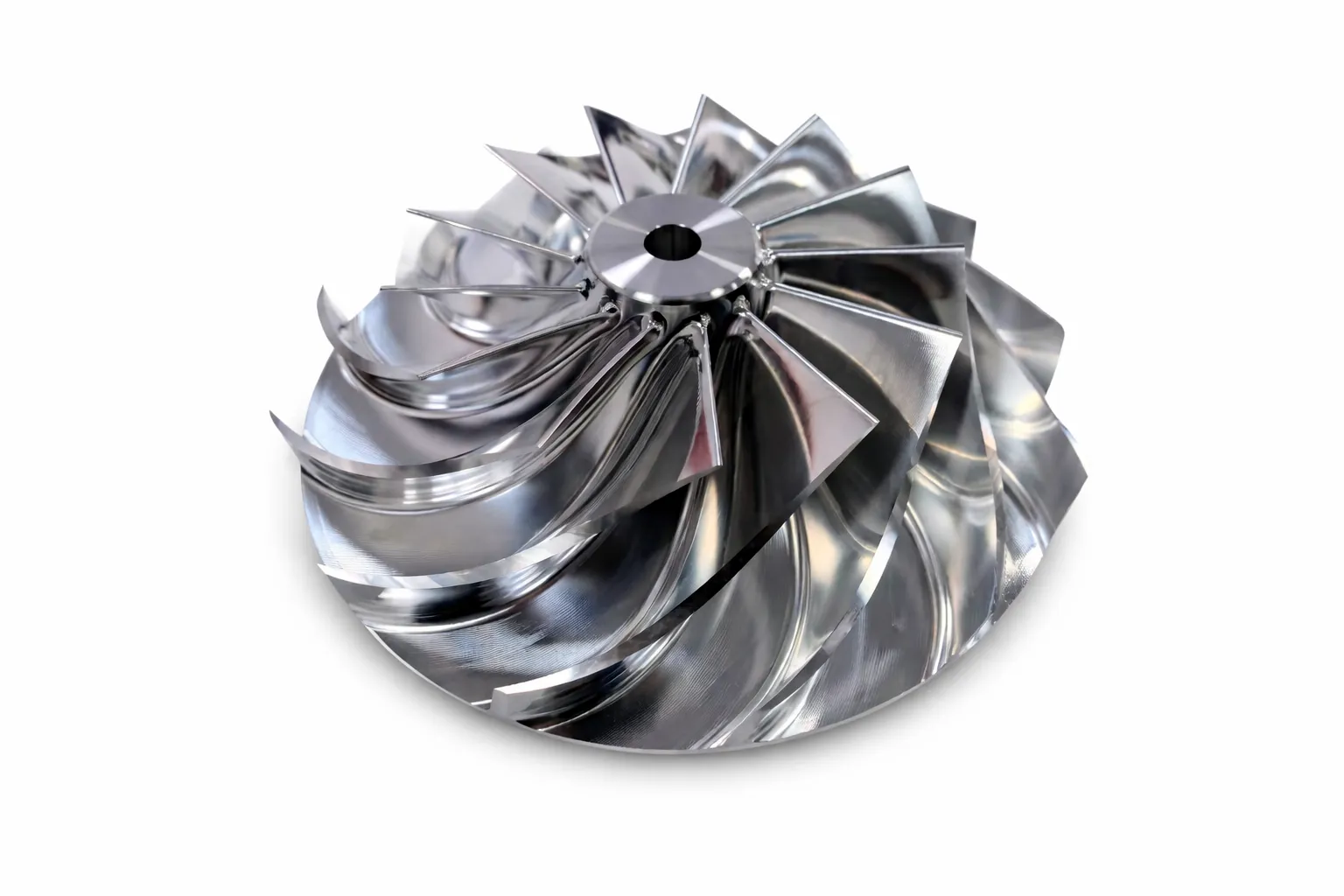
A customer required an aluminum impeller with complex blade geometry and high surface consistency.
Problem with 3-Axis
Required 4 setups → alignment inconsistency between blades
Tool interference occurred in deep blade channels
Surface finish varied between transitions due to segmented toolpaths
Manual polishing required → increased labor and inconsistency
Why 5-Axis Was Required
Continuous toolpath eliminated tool interference
Single setup ensured consistent blade positioning
Simultaneous motion allowed smooth surface transitions without step marks
Result
| Metric | 3-Axis | 5-Axis |
|---|---|---|
| Setups | 4 | 1 |
| Lead Time | 12 days | 8 days |
| Surface Consistency | Unstable | Stable |
| Total Cost | Higher | Lower overall |
How to Evaluate If Your Part Needs 5 Axis
Cost depends heavily on setup complexity and programming effort (see detailed cost guide).
Weighted Evaluation Score (Practical Method)
| Condition | Score |
|---|---|
| Continuous curved surfaces | +2 |
| Tight positional tolerance between features | +2 |
| Multi-direction machining required | +1 |
| Deep cavities / tool access issues | +1 |
How to Use
Score ≥ 3 → Recommend 5-axis machining
Score 1–2 → Consider 3+2 machining
Score 0 → Use 3-axis machining
FAQ
Is 5-axis CNC machining always better?
No. It is only beneficial when it reduces setups or enables geometry that simpler methods cannot achieve.
Is 5-axis machining faster?
Only for complex parts. For simple parts, programming time often makes it slower.
Can 3+2 replace 5-axis?
In many cases, yes — especially when continuous motion is not required.
Ready to Evaluate Your Part?
Most parts don’t need 5-axis machining — but misjudging this can add unnecessary cost and delay your project by weeks.
A quick manufacturability check based on your drawing is usually enough to determine the right process.
If you’re unsure, we can review your part and suggest the most cost-effective machining approach.

Upload your CAD file — we will review it as quickly as possible.