
3+2 vs Full 5 Axis Machining: Cost and Capability Comparison
Introduction
3+2 machining is often the more cost-effective choice for most multi-face parts, while full 5-axis machining is only necessary when continuous motion or complex geometry cannot be achieved with indexed positioning.
In many cases, choosing full 5-axis unnecessarily can increase cost by 20%–60%, based on typical machining quotes and industry benchmarks, without improving part quality.
Key Takeaways
3+2 machining is suitable for multi-face parts that can be machined in indexed positions
Full 5-axis is required for continuous curved surfaces and dynamic toolpaths
Cost increases by 20%–60% when full 5-axis is used unnecessarily (no continuous geometry)
Precision differences mainly appear in surface continuity and complex geometry alignment
The key decision factor is whether continuous motion is required, not part complexity alone
What Is the Real Difference?
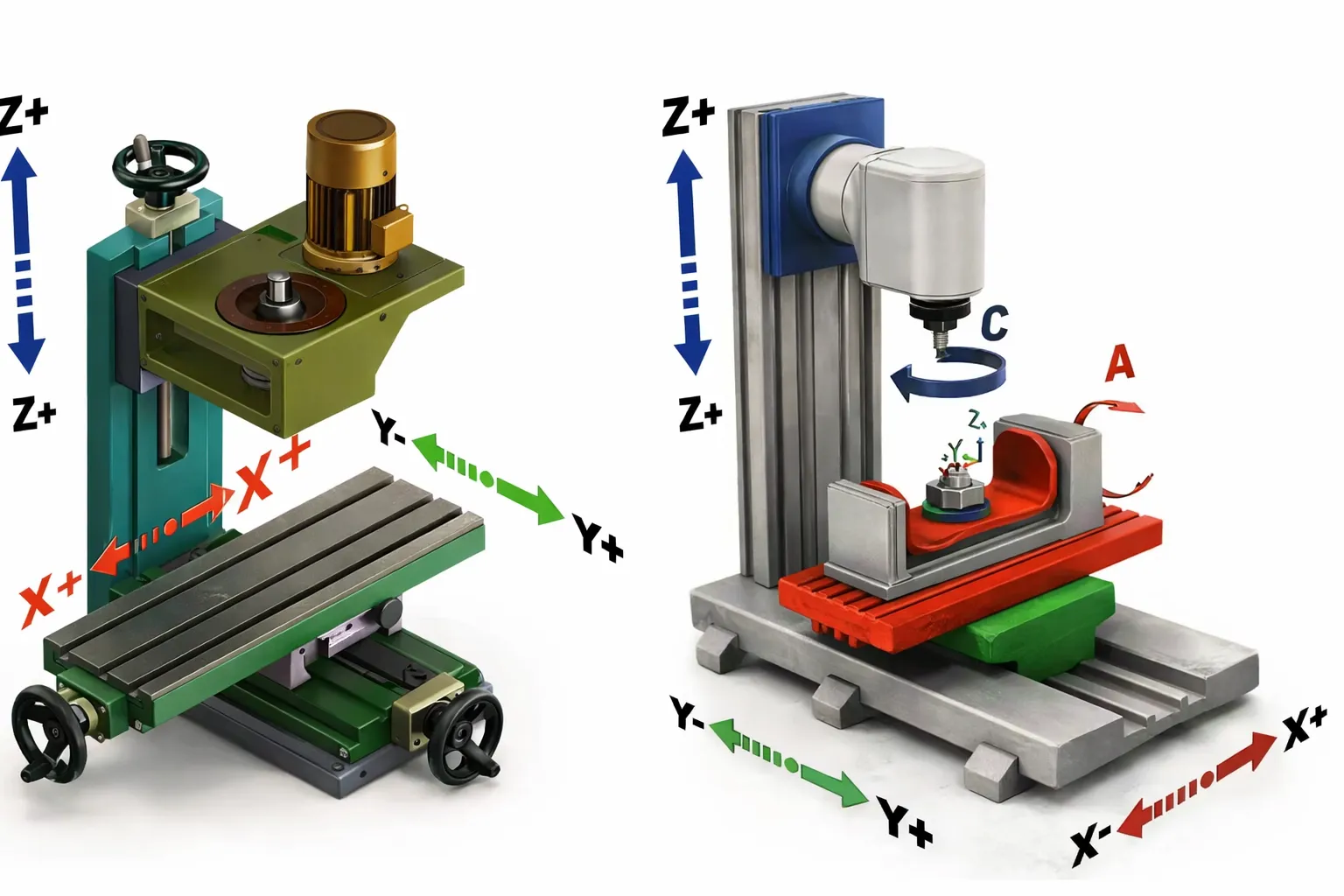
The real difference between 3+2 and full 5-axis machining is whether the tool moves continuously during cutting.
3+2 machining (indexed) → tool moves in fixed positions, machining one orientation at a time
Full 5-axis machining → tool moves continuously across multiple axes during cutting
This directly affects both cost and achievable geometry.
Cost vs Precision: What Actually Changes
Cost Difference
3+2 machining is typically lower cost because:
Simpler programming
Lower risk of collision
Shorter setup and simulation time
Full 5-axis increases cost when:
Continuous toolpath programming is required
Collision avoidance and simulation are complex
Machine time increases due to slower cutting strategies
Cost difference is most significant in low-volume, high-complexity parts where programming effort dominates total cost.
Precision Difference
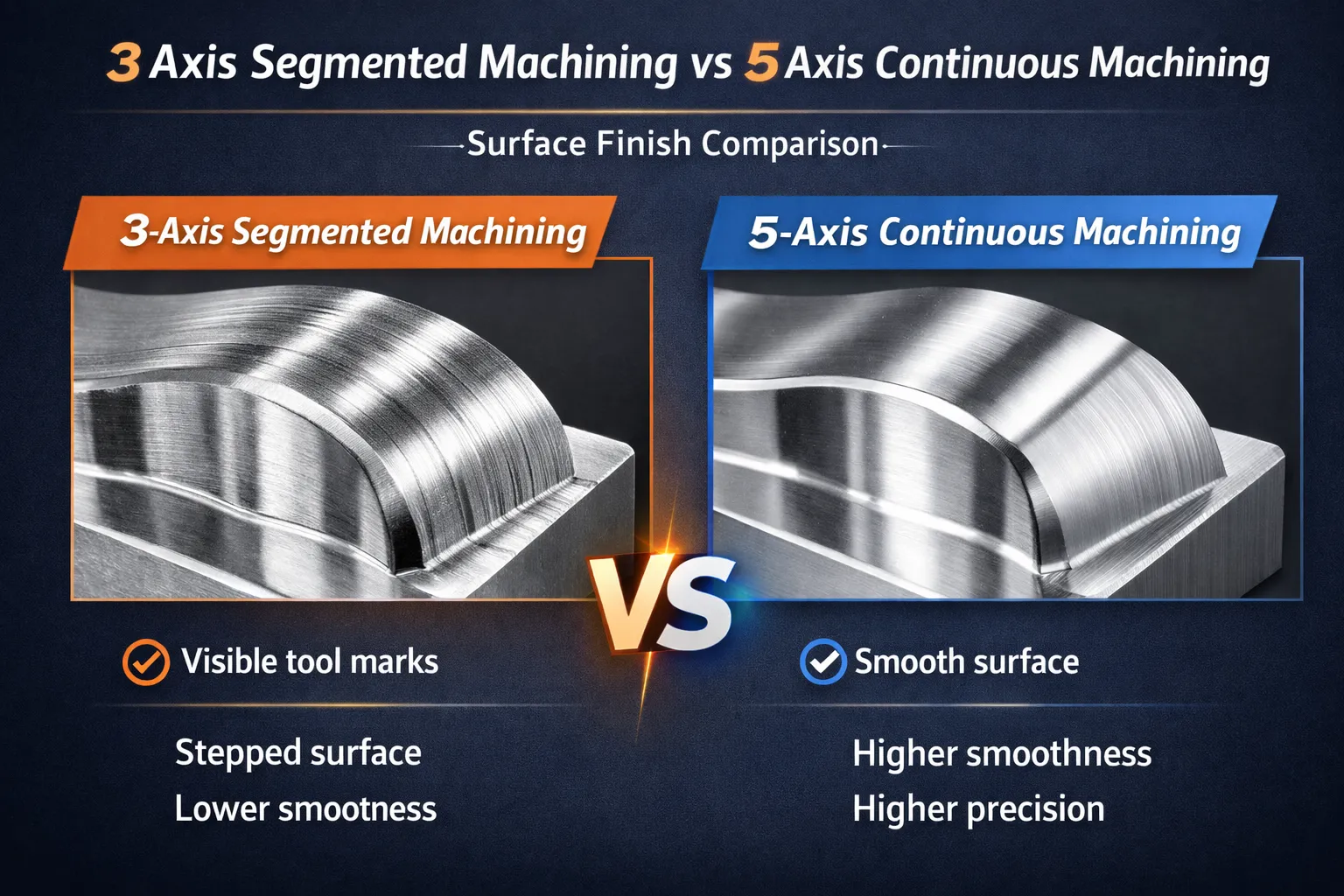
Precision differences are mainly about surface continuity and transition quality, not basic dimensional tolerance.
3+2 Machining
Good positional accuracy within each indexed setup
Minor variation between orientations
Indexed transitions may introduce minor surface variation, typically within ±0.01–0.02 mm depending on setup accuracy and fixture quality
Full 5-Axis Machining
Maintains continuous tool engagement
Eliminates transition marks between surfaces
Better for complex surface consistency
When 3+2 Machining Is the Better Choice
3+2 machining should be used when:
Part can be completed within ≤3 indexed positions
No continuous curved surfaces are required
Tool access is achievable without dynamic movement
Tolerance between features is moderate (>±0.02–0.05 mm)
→ In these cases, 3+2 provides the best balance of cost and capability.
When Full 5 Axis Machining Is Necessary
Full 5-axis machining is required when process limitations cannot be solved by indexing.
1. Continuous Curved Surfaces
Impellers
Turbine blades
Freeform surfaces
→ Continuous motion is required to maintain surface quality.
2. Complex Toolpath Requirements
Smooth transitions across multiple surfaces
No visible tool marks allowed
→ Full 5-axis ensures uninterrupted cutting.
3. Tool Interference Cannot Be Avoided
Deep cavities with angled walls
Restricted cutting angles
→ Dynamic tool orientation is required.
4. High Tolerance Alignment Across Surfaces
Multi-face precision assemblies
Tight positional relationships between features
→ Full 5-axis improves alignment stability across surfaces.
→ In these cases, full 5-axis becomes necessary.
Decision Logic (Most Important)
The correct choice depends on motion requirement and process stability.
Practical Decision Table
| Condition | Recommendation |
|---|---|
| ≤3 indexed positions sufficient | Use 3+2 |
| No continuous surface requirement | Use 3+2 |
| Continuous curved surfaces | Use full 5-axis |
| Tool interference present | Use full 5-axis |
| High tolerance alignment across surfaces | Use full 5-axis |
Engineering Questions
Can the part be machined with fixed orientations?
Is continuous surface finish required?
Will indexing introduce visible transitions?
Can tool access be achieved without collision?
Real Case: Choosing Between 3+2 and 5 Axis
Scenario
A customer designed a multi-face aluminum housing with angled features.
Initial Plan
Full 5-axis machining proposed
High programming complexity
Higher quoted cost
Engineering Review
Geometry could be machined in 3 indexed positions
No continuous surfaces required
Tool access achievable
Final Decision
Switched to 3+2 machining
Reduced programming complexity
Maintained required tolerance
Result
| Metric | Full 5-Axis | 3+2 Machining |
|---|---|---|
| Programming Time | High | Reduced |
| Cost | Higher | Reduced by ~20%–35% |
| Surface Quality | Equivalent | Equivalent |
| Lead Time | Longer | Shorter |
If full 5-axis had been used, additional programming complexity would have increased cost without improving part performance.
What Happens If You Choose Wrong
Overusing Full 5 Axis
Cost increases by 20%–60%
Longer programming and setup time
No improvement in functionality
Using 3+2 When 5 Axis Is Required
Visible surface transitions
Tool interference risk
Increased rework or scrap
Lead time may also increase due to additional programming iterations or rework cycles
FAQ
Is 3+2 machining less accurate than 5-axis?
No. It provides comparable accuracy for most multi-face parts.
When is full 5-axis absolutely required?
When continuous motion or complex geometry cannot be achieved through indexing.
Can 3+2 handle most industrial parts?
Yes, in most cases where continuous surfaces are not required.
Which One Should You Choose?
3+2 machining should be your default choice for cost efficiency.
Full 5-axis should only be used when it solves a real machining limitation.
Choosing incorrectly often leads to unnecessary cost or quality issues during production.

Upload your CAD file — we will review it as quickly as possible.