
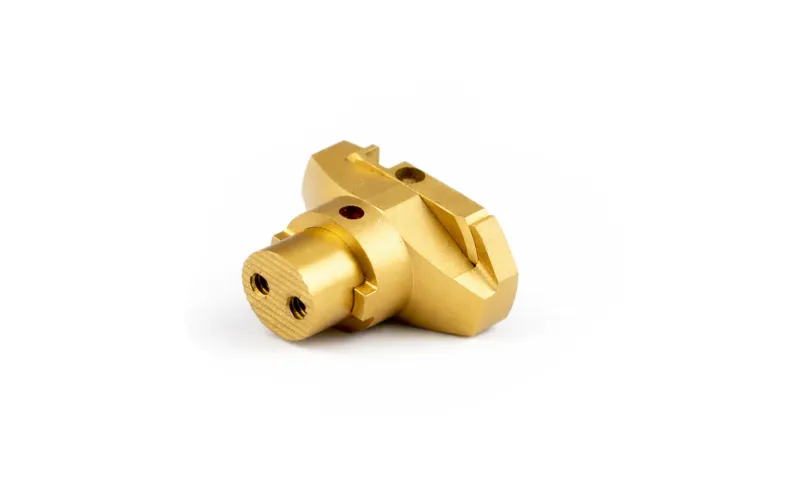
Chromate passivation treatment
Chromate Conversion Coating for CNC Parts
Why Choose Chromate Conversion Coating?
Chromate conversion coating is a chemical surface treatment that forms a thin protective film on metal parts. It allows CNC parts to gain reliable corrosion resistance and stable electrical conductivity with almost no dimensional change.
Main Benefits of Chromate Conversion Coating
Excellent corrosion resistance
Bare-film neutral salt spray resistance can typically reach 300–500 hours, and the protection can be even better when used together with painting or powder coating.Minimal effect on dimensions
The coating thickness is usually only 0.5–1 μm, so the impact on precision fitting surfaces is very small.Maintains conductivity
Class 3 coatings can provide corrosion protection while still meeting grounding and electrical bonding requirements.Improves paint adhesion
As a pretreatment before painting, it can significantly improve the adhesion of liquid paint and powder coating.Simple and cost-effective process
It is usually applied by immersion, making it efficient and suitable for batch production.
How to Choose the Right Type
Chromate conversion coating is commonly divided into hexavalent chromate and trivalent chromate systems. The right choice depends on your corrosion, conductivity, and compliance requirements.
| If You Need… | Recommended Type | Appearance | Corrosion Resistance (Bare Film) | Typical Applications |
|---|---|---|---|---|
| Maximum corrosion protection | Hexavalent chromate, Class 1A | Gold to olive green | 300–500 hours salt spray | Aerospace structures, marine equipment, military parts |
| Corrosion protection plus conductivity | Hexavalent chromate, Class 3 | Light iridescent to transparent | 72–144 hours salt spray | Electronic housings, conductive connectors, EMC parts |
| Better environmental compliance with good corrosion resistance | Trivalent chromate | Light purple transparent, close to base metal color | 360+ hours | Consumer electronics, automotive parts, export products |
Simple rule:
If you need maximum corrosion protection, choose Class 1A.
If you need conductivity as well as corrosion resistance, choose Class 3.
If you need better environmental compliance, trivalent chromate is usually the preferred option.
Environmental note:
Hexavalent chromium is subject to stricter environmental restrictions. For export-oriented projects, trivalent chromate or chromium-free alternatives are often preferred.
Process Capabilities
| Item | Description |
|---|---|
| Suitable Materials | Aluminum alloys (2000 / 5000 / 6000 / 7000 series), magnesium alloys, zinc alloys |
| Coating Thickness | 0.5–1 μm |
| Available Colors | Gold, olive green, iridescent, light transparent finish, depending on requirement |
| Corrosion Resistance | Bare-film neutral salt spray resistance typically 72–500 hours; with additional coating systems it can exceed 1000 hours |
| Conductivity | Class 3 coatings can meet electrical bonding and grounding requirements |
| Standards | MIL-DTL-5541, QPL-81706, AMS 2473, or customer-defined specifications |
Performance Grade Reference
| Grade | Thickness (μm) | Neutral Salt Spray (Hours) | Conductivity | Typical Applications |
|---|---|---|---|---|
| Class 3 (low-resistance type) | 0.3–0.8 | 72–144 | Conductive, suitable for electrical bonding | Avionics, conductive connectors, electronic enclosures |
| Class 1A (high-corrosion-resistance type) | 0.5–1.0 | 300–500 | Non-conductive | Aircraft structures, marine equipment, long-term exposed parts |
| Trivalent high-corrosion-resistance type | 0.5–1.0 | 360+ | Low contact resistance | Automotive parts, consumer electronics, export products |
These figures are typical references. Actual performance may vary depending on base material, pretreatment quality, and process parameters.
Influence on Part Dimensions
The dimensional effect of chromate conversion coating is extremely small and is often negligible.
Typical coating thickness is only 0.5–1 μm
For threaded holes and precision fitting surfaces, the effect is usually very small, and masking is often unnecessary
Class 3 coatings can maintain low-resistance electrical contact while adding corrosion protection
Compared with anodizing (10–25 μm) or powder coating (50–150 μm), chromate conversion coating is much more suitable for precision parts that need tight dimensional control.
Typical Applications
| Industry | Typical Parts | Main Value |
|---|---|---|
| Aerospace | Aircraft structures, engine accessories, landing gear parts, airborne equipment housings | High-level corrosion protection while maintaining conductivity and meeting military standards |
| Consumer Electronics | Phone mid-frames, laptop housings, smart device frames | Thin protective layer with almost no dimensional change and retained conductivity |
| Industrial Manufacturing | Instrument panels, control boxes, equipment housings, precision brackets | Improved corrosion resistance and longer service life |
| Automotive | Body structures, chassis parts, engine components, aluminum wheels | Reliable corrosion protection for lightweight metal parts |
| Medical Devices | Surgical tools, equipment housings, precision components | Stable corrosion-resistant surfaces for reliable use |
FAQ
1) What is the difference between hexavalent and trivalent chromate?
Hexavalent chromate generally offers strong corrosion resistance, but it is more restricted by environmental regulations. Trivalent chromate is more environmentally friendly and is commonly preferred for export and compliance-focused projects.
2) Can chromate-converted parts be shipped directly?
Yes. Once the conversion film is fully formed, it can serve as a finished protective layer and can be used directly for many end products. If higher wear resistance or decorative color is needed, additional painting can be added.
3) Will chromate conversion coating affect threaded holes or fitting dimensions?
The effect is usually very small. Since the coating thickness is only 0.5–1 μm, most precision fitting areas do not require extra allowance or masking.
4) What is the difference between chromate conversion coating and anodizing?
Anodizing forms a much thicker oxide layer, usually 10–25 μm, with higher hardness and wear resistance, but it changes dimensions more and is generally non-conductive. Chromate conversion coating is much thinner, has minimal dimensional impact, and can retain conductivity, making it better for conductive or precision-fit parts.
5) How should the requirement be specified?
To define the coating clearly, it is helpful to confirm:
Part material and alloy grade
Required corrosion resistance level, such as target salt spray hours
Whether electrical conductivity is required, such as Class 3
Whether the project needs export environmental compliance
Based on this information, the right solution can be selected more accurately.
Conclusion
Chromate conversion coating is an efficient way to give CNC precision parts a thin but highly effective protective layer. Whether your project needs aerospace-level corrosion protection or conductivity for electronic parts, it offers a practical solution with almost no dimensional change.
If the material, corrosion target, conductivity requirement, and compliance requirement are confirmed early in the project, it becomes much easier to choose the right conversion coating system.